
Mathematics
Rajbeer is a farmer. He has a plot of land in the shape of a quadrilateral ABCD as shown in the figure. In ABCD, AB ∥ CD and AD ∥ BC. He divided the field into two parts, viz, triangle BCE and trapezium CDAE by making an embankment CE such that CE = AD.
Based on the above information, answer the following questions :
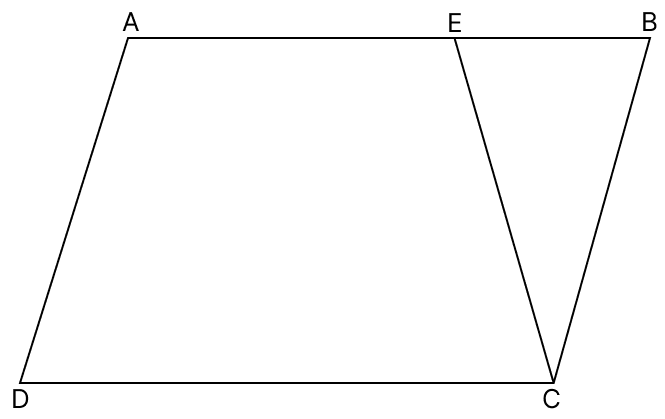
1. ABCD is a :
(a) Rectangle
(b) Parallelogram
(c) Square
(d) Trapezium
2. ∠A is equal to :
(a) ∠D
(b) ∠B
(c) ∠C
(d) ∠E
3. ∠DCE is equal to :
(a) ∠E
(b) ∠A
(c) ∠D
(d) ∠B
4. Which of the following is correct?
(a) ΔAEC ≅ ΔEAD
(b) ΔACE ≅ ΔAED
(c) ΔCEA ≅ ΔEAD
(d) none of these
5. Diagonal DE is equal to :
(a) diagonal DB
(b) diagonal AC
(c) DC
(d) BC
Rectilinear Figures
3 Likes
Answer
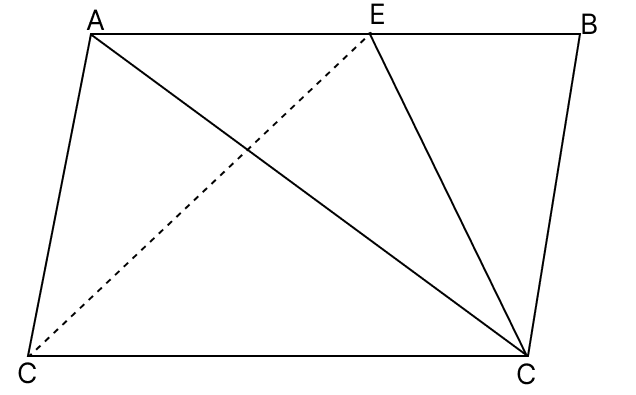
1. Given,
AB ∥ CD and AD ∥ BC
Since both pairs of opposite sides are parallel, the quadrilateral ABCD is a parallelogram.
Hence, option (b) is the correct option.
2. Given,
AD = CE
In trapezium CDAE:
AD and CE are the non-parallel sides and they are equal.
∴ CDAE is an isosceles trapezium.
∠A = ∠E [Angles on the same base of an isosceles triangle area equal]
Hence, option (d) is the correct option.
3. Given,
AD = CE
∴ CDAE is an isosceles trapezium.
∠DCE = ∠ADC [Base angles of an isosceles trapezium are equal.]
Hence, option (c) is the correct option.
4. In ΔAEC and ΔAED,
AD = CE (Given)
AE = AE (common side)
∠AEC = ∠EAD [Base angles of an isosceles trapezium are equal]
∴ ΔAEC ≅ ΔEAD [By S.A.S. axiom]
Hence, option (a) is the correct option.
5. As ADCE is an isosceles trapezium and diagonals of an isosceles trapezium are equal in length.
Hence, option (b) is the correct option.
Answered By
1 Like
Related Questions
The diagonals of a quadrilateral are equal and they bisect each other. The quadrilateral is definitely a :
rectangle
square
rhombus
parallelogram
PQRS is a rhombus in which PQ = 6 cm and ∠PQR = 120°. The length of the diagonal QS is :
6 cm
7 cm
8 cm
11 cm
Assertion (A) : The two diagonals of a rectangle are equal and bisect each other at right angles.
Reason (R) : Every rectangle is a square.
A is true, R is false
A is false, R is true
Both A and R are true
Both A and R are false
Assertion (A) : If diagonals of a quadrilateral are equal, then it must be a rectangle.
Reason (R) : The diagonals of a rectangle are equal.
A is true, R is false
A is false, R is true
Both A and R are true
Both A and R are false