
Physics
A ray of light PQ is incident normally on the face AB of an equilateral prism. The ray gets totally reflected from the surface AC.

Calculate:
(a) the angle of deviation at AC.
(b) the angle of incidence at BC.
Refraction Plane Surfaces
16 Likes
Answer
From the below diagram,
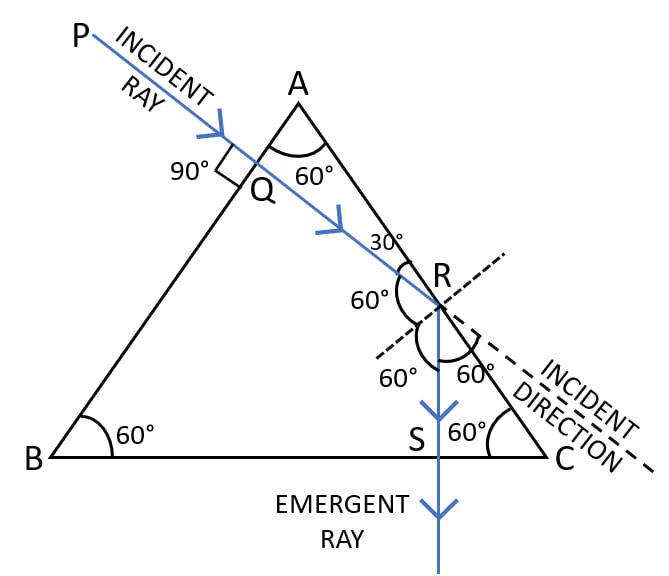
(a) As, the incident ray and emergent ray makes an angle of 60° with each other.
So, angle of deviation at AC is 60°.
(b) Here, emergent ray is falling normally on face BC.
So, angle of incidence at BC is 0°.
Answered By
9 Likes
Related Questions
State two properties of magnetic lines of force around a straight conductor carrying current.
The heat capacity of a milk cooker is 450 JK-1. Calculate the rise in the temperature when it absorbs 9000 J of heat.
The figure below shows a bicycle dynamo which is fitted to the tyre. When the wheels of the bicycle rotate, the spindle of dynamo attached to magnets rotate and the bulb glows.

(a) Name the phenomenon that takes place when the bulb glows while the person rides the bicycle.
(b) What will be the effect on the brightness of the bulb when the rider increases the speed of the bicycle?
Define background radiation. Give one internal source of this radiation.