
History & Civics
With reference to the Rise of Fascism in Italy, explain the following :
(a) What were the factors responsible for the rise of Fascism in Italy?
(b) Describe a decisive action taken by Mussolini with the aim of making Italy a colonial power.
Rise of Dictatorships
1 Like
Answer
(a) There were many factors responsible for the rise of Fascism in Italy.
- Discontentment after the Treaty of Versailles : Italy could get only Southern Tyrol and Trentino, and the Coastal Regions of Dalmatia. She could get no part of the German and Turkish colonial empire.
- Economic Crisis : Due to the expenses of World War I, Italy's national debt increased manifold, and people had to suffer for basic necessities like food and grains.
- Weak Government and Political Instability : The people were greatly distressed due to the weak policies and inefficiency of the government, which was incapable of solving their problems. Since no single party could gain clear majority in the elections, there was complete instability after 1918.
- Activities of the Socialists : The Socialists intensified tensions with their revolutionary ideas, while the Communists plotted to overthrow the government. Amid growing lawlessness and insecurity, people sought a strong party to restore peace and prosperity.
- Failure of the League of Nations : The League of Nations, which was established to maintain peace in the world, failed to check the rise of Dictatorship in Germany and Italy.
(b) Mussolini wanted to revive the glory of the Old Roman Empire. Italy adopted an aggressive policy and captured Abyssinia and Albania, with the aim of making Italy a colonial power.
Answered By
3 Likes
Related Questions
How did the following prove important causes of the Rise of Fascism in Italy?
(a) Discontent in Italy after the Treaty of Versailles.
(b) Economic Crisis of 1929.
(c) Weak government of Italy.
With reference to the Rise of Nazism in Germany, explain the following :
(a) Anti-semitic Propaganda
(b) Economic Crisis in Germany after the First World War.
(c) Personality of Hitler.
With reference to the comparative study of Fascism and Nazi Ideologies explain the following:
(a) Any three similarities between the Fascist and Nazi Ideologies.
(b) Any three differences between the Fascist and Nazi Ideologies.
With reference to the given picture, answer the following questions :
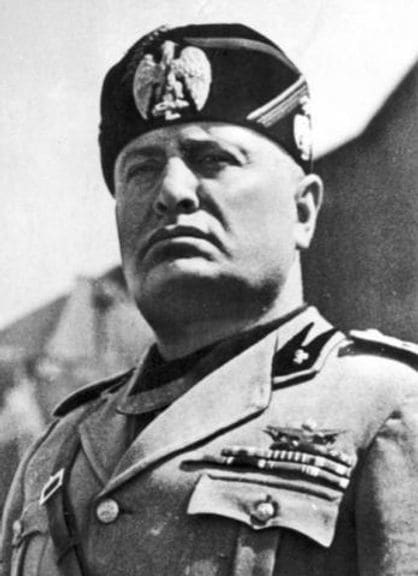
(a) Identify the personality and give the popular name he was called.
(b) Name the ideology and two of its features propounded by him.
(c) Give two reasons for his meteoric rise at the helm of affairs.