Mathematics
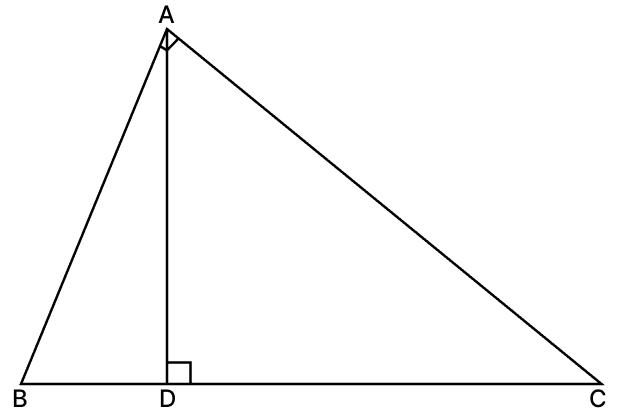
In a right-angled ΔABC, right-angled at A, if AD ⟂ BC such that AD = p, BC = a, CA = b and AB = c, then:
p2 = b2 + c2
p2 = b2 c2
Similarity
1 Like
Answer
Given,
Area of a right angled triangle =
Area of triangle ABC =
Area of triangle ABC = …….(1)
Also,
Area of triangle ABC =
Area of triangle ABC = …..(2)
From equation (1) and (2), we get :
bc = ap
bc = ap
a =
Applying Pythogoras theorem to right-angled triangle ABC:
Hence, option 4 is the correct option.
Answered By
3 Likes
Related Questions
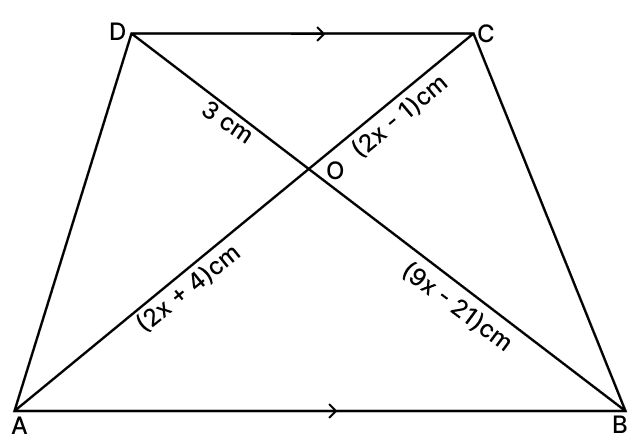
In the given figure, AB ∥ CD and OA = (2x + 4) cm, OB = (9x − 21) cm, OC = (2x − 1) cm and OD = 3 cm. Then x equals:
2.1
3
4
6
The shadow of a 5 m long stick is 2 m long. At the same time the length of the shadow of a 12.5 m high tree is:
3 m
3.5 m
4.5 m
5 m
In a right-angled ΔABC in which ∠A = 90°, if AD ⟂ BC, then which of the following statements is correct?
AB = BD × AD
AB2 = BC × BD
AB2 = BD × DC
AB2 = BC × DC
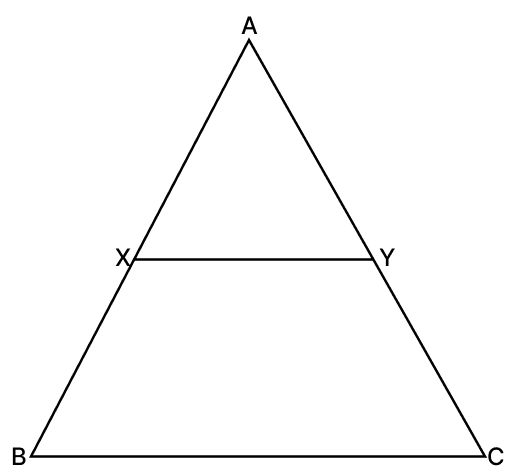
In the adjoining figure, XY is parallel to BC. If XY divides the triangle into two equal parts, then equals: