
Physics
A scientist while performing an experiment desires that no incident light escapes from the top of a glass block. He varies the angle X continuously and finally manages to achieve his objective. Which of the following options describes the correct answer?
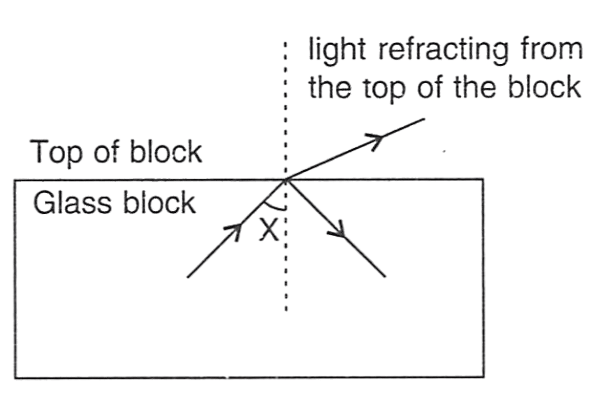
| Angle | Effect Produced | |
|---|---|---|
| (a) | Decreased | Total Internal Reflection |
| (b) | Decreased | Total Internal Refraction |
| (c) | Increased | Total Internal Refraction |
| (d) | Increased | Total Internal Reflection |
- Option (a)
- Option (b)
- Option (c)
- Option (d)
Refraction Plane Surfaces
6 Likes
Answer
Option (d)
Reason — As a ray travels from denser medium to rarer medium and if it's angle of incidence is greater than the critical angle then total internal reflection occurs so scientist must increase angle X till it beocmes greater than the critical angle to achieve total internal reflection.
Answered By
3 Likes
Related Questions
At angle of incidence equal to the critical angle, the angle of refraction is:
- 0°
- 30°
- 90°
- 180°
The condition required for total internal reflection to take place is:
- light ray passes from a rarer to denser medium
- light ray passes from a denser to rarer medium
- angle of incidence is less than critical angle
- none of the above
When a ray of light travels from substance A to substance B and reaches their boundary, it suffers total internal reflection. Out of the following possibilities, which one is correct?
Angle i Substance B (a) i < C Optical density of A is less than B (b) i = C Optical density of A is more than B (c) i > C Optical density of A is less than B (d) i > C Optical density of A is more than B - Option (a)
- Option (b)
- Option (c)
- Option (d)
An equilateral prism can be used to deviate a ray of light through:
- 30°
- 60°
- 75°
- 90°