Mathematics
Show that the circle drawn on any one of the equal sides of an isosceles triangle as diameter bisects the base.
Circles
26 Likes
Answer
Let circle be drawn on one of the equal sides AB of the isosceles triangle ABC as shown in the figure below:
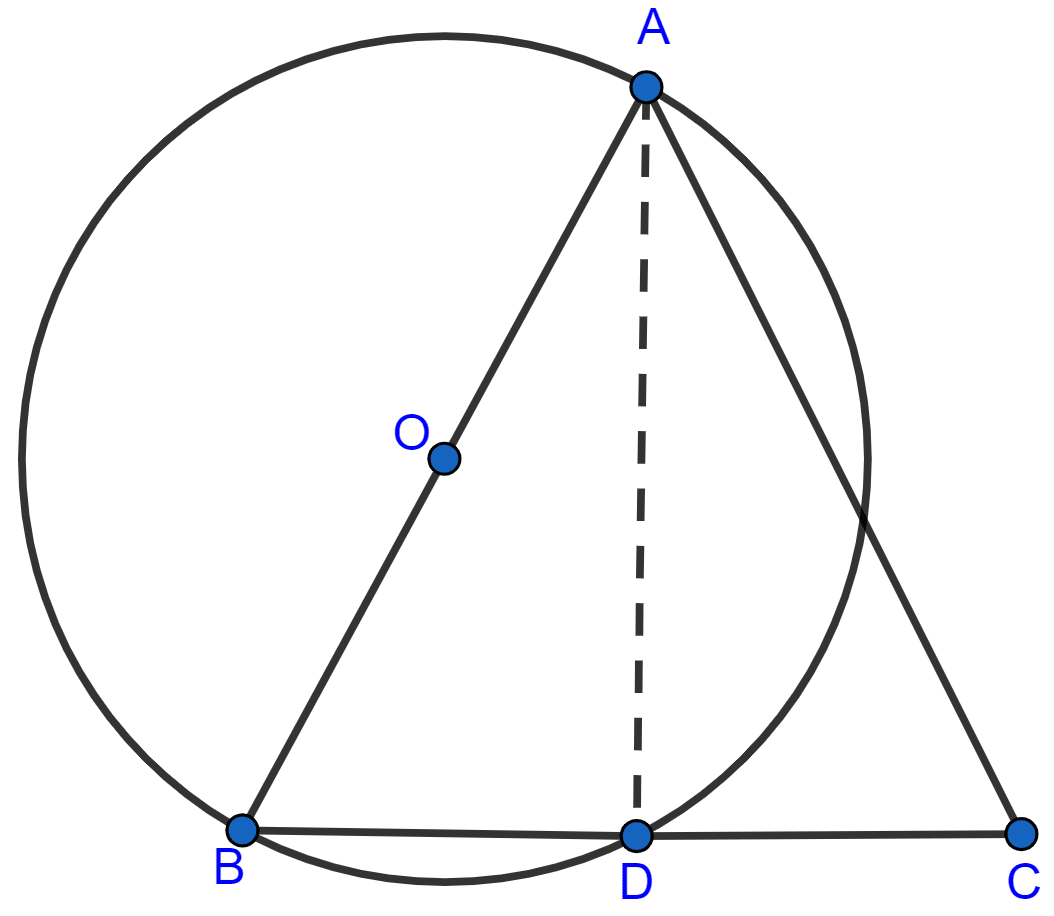
We have ∠ADB = 90° [Angle in a semi-circle is a right angle]
But,
⇒ ∠ADB + ∠ADC = 180° [Linear pair]
⇒ 90° + ∠ADC = 180°
⇒ ∠ADC = 180° - 90°
⇒ ∠ADC = 90°.
In ∆ABD and ∆ACD, we have
⇒ ∠ADB = ∠ADC [Each 90°]
⇒ AB = AC [Given]
⇒ AD = AD [Common]
Hence, ∆ABD ≅ ∆ACD by RHS congruence criterion.
By, C.P.C.T we get :
BD = DC
Hence, the circle bisects base BC at D.
Answered By
8 Likes
Related Questions
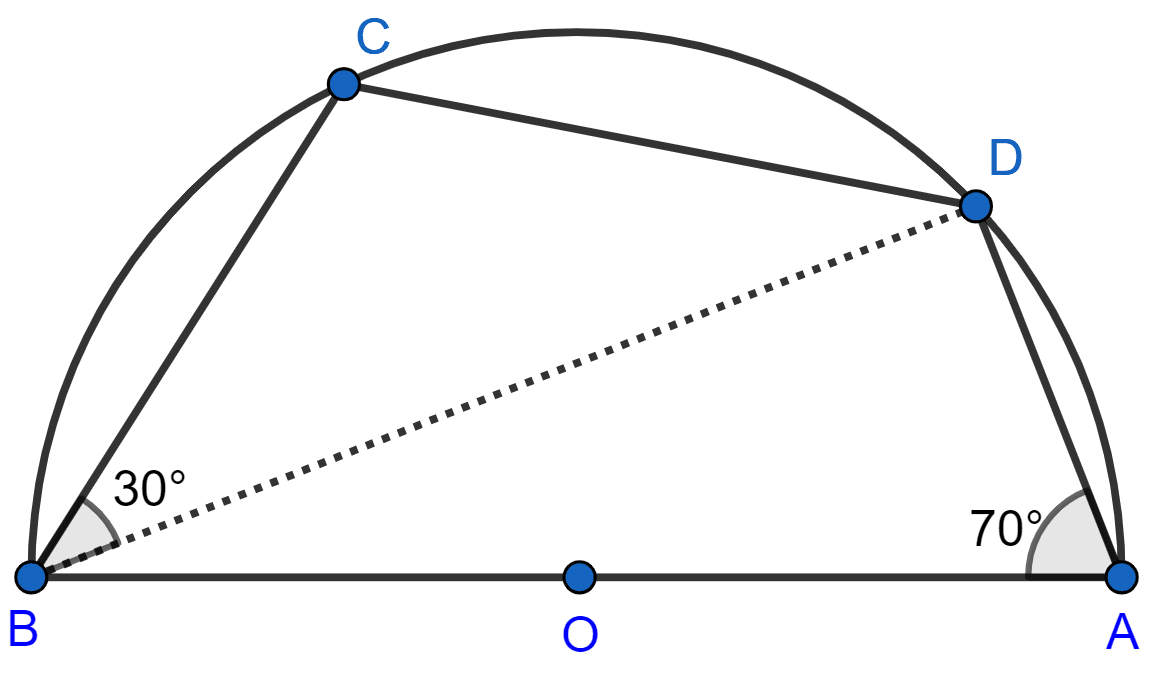
In the given figure, C and D are points on the semi-circle described on AB as diameter.
Given angle BAD = 70° and angle DBC = 30°, calculate angle BDC.
In cyclic quadrilateral ABCD, ∠A = 3∠C and ∠D = 5∠B. Find the measure of each angle of the quadrilateral.
Bisectors of vertex angles A, B and C of a triangle ABC intersect its circumcircle at points D, E and F respectively. Prove that angle EDF = 90° - ∠A.
In the figure, AB is the chord of a circle with centre O and DOC is a line segment such that BC = DO. If ∠C = 20°, find angle AOD.