
Physics
Show that the sum of kinetic energy and potential energy (i.e., total mechanical energy) is always conserved in the case of a freely falling body under gravity (with air resistance neglected) from a height h by finding it when
(i) the body is at the top,
(ii) the body has fallen a distance x,
(iii) the body has reached the ground.
Work, Energy & Power
175 Likes
Answer
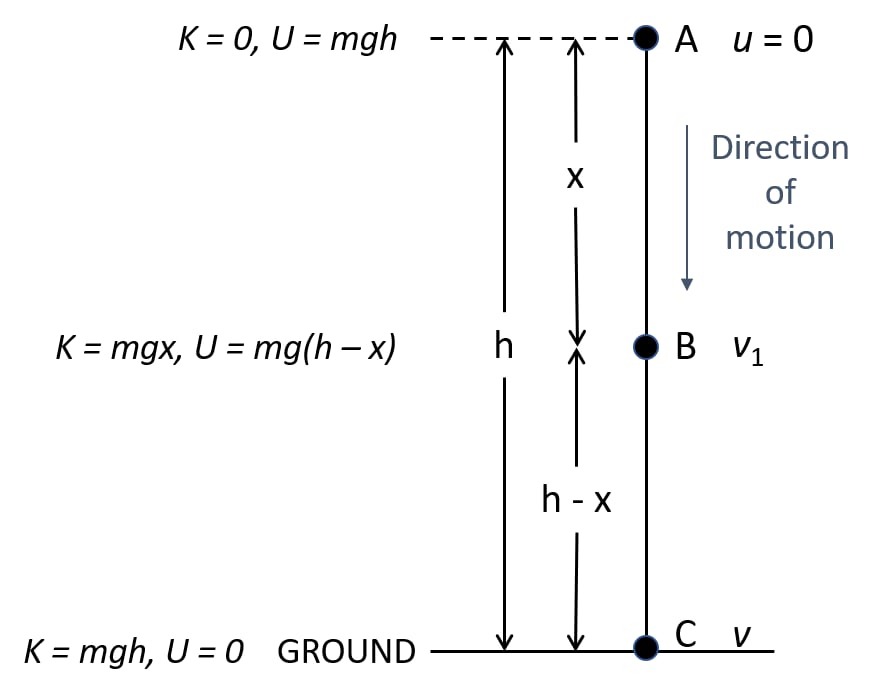
We know that,
Kinetic energy + potential energy = constant
So, when a body falls from a height h under free fall
(i) At the position A — height h
Initial velocity = 0
Kinetic energy K = 0
Potential energy U = mgh
As, Total energy = KE + PE
Total energy = 0 + mgh
Total energy = mgh (1)
(ii) At the position B — when it has fallen a distance x.
Then, velocity at B = v1
Then u = 0, s = x, a = g
From equation of motion:
v2 = u2 + 2aS
v12 = 0 + 2gx = 2gx
∴ Potential energy U = mg (h – x)
Hence, total energy = K + U = mgx + mg (h – x) = mgh
Total energy = mgh (2)
(iii) At position C (on the ground) —
Let the velocity acquired by the body on reaching the ground be v2.
Then u = 0, s = h, a = g
We know,
v2= u2 + 2aS
v22 = 0 + 2gh
v22 = 2gh
And potential energy U = 0 (at the ground when h = 0)
So, total energy = K + U = mgh + 0
Total energy = mgh (3)
Thus, from equation (1), (2) and (3) we note that the total mechanical energy i.e. the sum of kinetic energy and potential energy always remain constant at each point of motion and it is equal to the initial potential energy at height h.
Answered By
77 Likes
Related Questions
A pendulum with a bob of mass m is oscillating on either side from its resting position A between the extremes B and C at a vertical height h above A. What is the kinetic energy K and potential energy U when the pendulum is at positions
(i) A, (ii) B and (iii) C?
Name the type of energy possessed by the bob of a simple pendulum when it is at
(a) the extreme position,
(b) the mean position, and
(c) between the mean and extreme positions.
A pendulum is oscillating on either side of its rest position. Explain the energy changes that take place in the oscillating pendulum. How does the mechanical energy remain constant in it? Draw necessary diagram.
A ball of mass 0.20 kg is thrown vertically upwards with an initial velocity of 20ms-1. Calculate the maximum potential energy it gains as it goes up.