
Mathematics
Each side of a rhombus is 10 cm and one of its diagonals is 16 cm, length of other diagonal will be :
11 cm
12 cm
13 cm
15 cm
Rectilinear Figures
1 Like
Answer
Let ABCD be the rhombus and the diagonals intersect at point O.
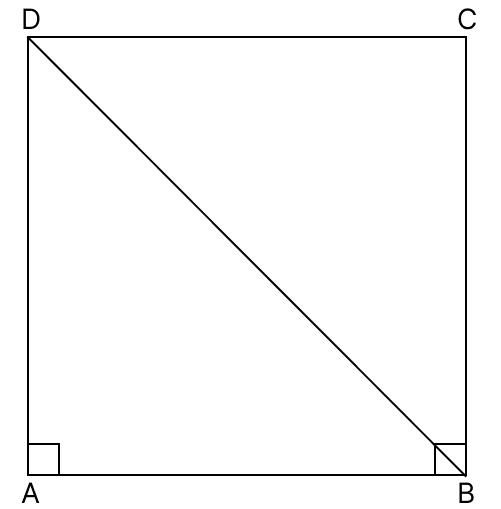
Let diagonal AC = 16 cm.
We know that,
Diagonals of rhombus bisect each other at right angles.
∴ AO = OC = = 8 cm and BO = OD = x cm (let).
In right angle triangle AOB,
By pythagoras theorem,
⇒ (Hypotenuse)2 = (Perpendicular)2 + Base2
⇒ AB2 = AO2 + OB2
⇒ 102 = 82 + x2
⇒ 100 = 64 + x2
⇒ x2 = 100 - 64
⇒ x2 = 36
⇒ x = = 6 cm.
From figure,
⇒ BD = BO + OD = 6 + 6 = 12 cm.
Hence, option 2 is the correct option.
Answered By
2 Likes
Related Questions
If one angle of a parallelogram is 30° less than twice the smallest angle, then measure of each angle will be :
60°, 80°, 80°, 140°
70°, 110°, 70°, 110°
60°, 120°, 60°, 120°
75°, 105°, 75°, 105°
ABCD is a parallelogram in which AB = 9.5 cm and its perimeter is 30 cm. Length of each side of parallelogram ABCD is :
AB = 9.5 cm, DC = 9.5 cm, BC = 5.5 cm, DA = 5.5 cm
AB = 9.5 cm, BC = 9.5 cm, DC = 5.5 cm, DA = 5.5 cm
DC = 5.5 cm, BC = 5.5 cm, AB = 9.5 cm, AD = 9.5 cm
none of these
ABCD is a rhombus. If ∠A = 70°, then ∠CDB will be :
45°
65°
55°
75°
In a parallelogram, an angle is th of its adjacent angle, then angles of the parallelogram are :
80°, 100°, 80°, 100°
70°, 110°, 70°, 110°
60°, 120°, 60°, 120°
none of these