
Mathematics
The sides of a right-angled triangle containing the right angle are (5x) cm and (3x - 1) cm. If its area is 60 cm2, find its perimeter.
Mensuration
1 Like
Answer
Let ABC be a right-angled triangle,
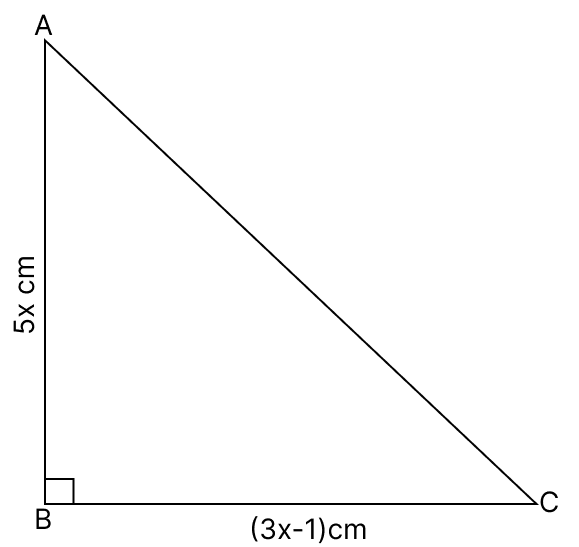
AB = 5x cm and BC = (3x – 1) cm
We know that,
Area of △ ABC = × base × height
Substituting the values we get,
⇒ 60 = × (3x - 1) × 5x
⇒ 120 = 5x(3x – 1)
⇒ 120 = 15x2 - 5x
⇒ 15x2 - 5x - 120 = 0
⇒ 5(3x2 - x - 24) = 0
⇒ 3x2 - x - 24 = 0
⇒ 3x2 – 9x + 8x – 24 = 0
⇒ 3x(x – 3) + 8(x - 3) = 0
⇒ (3x + 8)(x - 3) = 0
⇒ 3x + 8 = 0 or x - 3 = 0
⇒ 3x = -8 or x = 3
⇒ x = or x = 3.
Since, x cannot be negative. So, x = 3.
⇒ AB = 5 × 3 = 15 cm
⇒ BC = (3 × 3 – 1) = 9 – 1 = 8 cm
In right angled △ABC,
Using Pythagoras theorem,
AC2 = AB2 + BC2
Substituting the values we get,
⇒ AC2 = 152 + 82
⇒ AC2 = 225 + 64
⇒ AC2 = 289
⇒ AC =
⇒ AC = 17 cm.
Perimeter of a triangle = Sum of all the sides of a triangle
= AB + BC + AC
= 15 + 8 + 17
= 40 cm.
Hence, perimeter of the triangle = 40 cm.
Answered By
2 Likes
Related Questions
Find the perimeter and area of an equilateral triangle whose height is 12 cm. Write your answers, correct to two decimal places.
The lengths of two sides of a right triangle containing the right angle differ by 2 cm. If the area of the triangle is 24 cm2, find the perimeter of the triangle.
Each of the equal sides of an isosceles triangle is 2 cm more than its height and the base of the triangle is 12 cm. Find the area of the triangle.
Find the area of an isosceles triangle, each of whose equal sides is 13 cm and base 24 cm.