
Mathematics
From a solid wooden cylinder of height 28 cm and diameter 6 cm, two conical cavities are hollowed out. The diameters of the cone are also of 6 cm and height 10.5 cm.
Taking π = , find the volume of remaining solid.
Mensuration
23 Likes
Answer
Given,
Diameter of solid wooden cylinder (D) = 6 cm
Radius of solid wooden cylinder (R) = cm = 3 cm
Height of solid wooden cylinder (H) = 28 cm
Diameter of cone (d) = 6 cm
Radius of cone (r) = cm = 3 cm
Height of cone (h) = 10.5 cm
Volume of cylinder (V) = πr2h
Volume of single cone (v) = πR2H
Volume of two conical cavities = 2 x 99 = 198 cm2
Volume of remaining solid = Volume of cylinder - Volume of 2 conical cavities = 792 - 198 = 594 cm2.
Hence, volume of remaining solid = 594 cm2.
Answered By
10 Likes
Related Questions
A cubical block of side 7 cm is surmounted by a hemisphere. What is the greatest diameter that the hemisphere can have ? Also, find the surface area of the solid.
A wooden article was made by scooping out a hemisphere from each end of a solid cylinder (as shown in the adjoining figure). If the height of the cylinder is 10 cm and its base is of radius 3.5 cm, find the total surface area of the article.

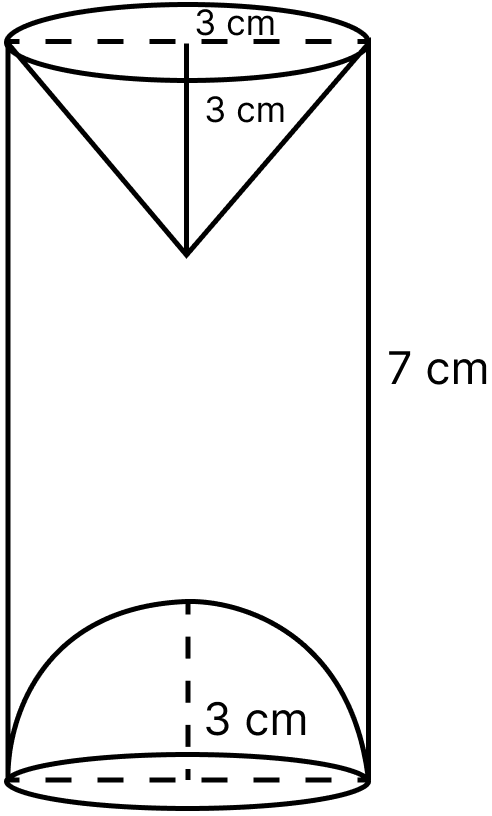
A hemispherical and conical hole are scooped out of a solid wooden cylinder. Find the volume of the remaining solid where the measurements are as follows :
The height of the cylinder is 7 cm, radius of each hemisphere, cone and cylinder is 3 cm. Height of cone is 3 cm. Give your answer correct to nearest whole number. Take π =
A toy is in the form of a cone of radius 3.5 cm mounted on a hemisphere of same radius. If the total height of the toy is 15.5 cm, find the total surface area of the toy.