Mathematics
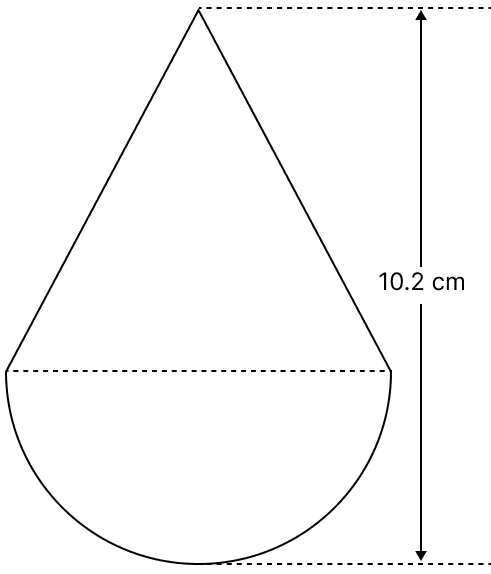
A solid wooden toy is in the form of a cone mounted on a hemisphere. The radii of the hemisphere and the base of the cone are 4.2 cm each and the total height of the toy is 10.2 cm. Calculate :
(i) the volume of wood used in the toy
(ii) the total surface area of the toy, correct to two places of decimal.
Mensuration
2 Likes
Answer
Given,
The solid wooden toy is in the shape of a right circular cone mounted on a hemisphere.
Radius of hemisphere, r = 4.2 cm
Total height, h = 10.2 cm
Height of conical part, H = 10.2 - 4.2 = 6 cm
(i) Volume of wood used in toy = Volume of cone + Volume of hemisphere
Hence, the volume of wood used in the toy is 266.11 cm3.
(ii) By formula,
l2 = r2 + h2
⇒ l2 = 4.22 + 62
⇒ l2 = 17.64 + 36
⇒ l2 = 53.64
⇒ l = = 7.32 cm
Total surface area of toy = Curved surface area of cone + curved surface area of hemisphere
Hence, the total surface area of the toy is 207.56 cm2.
Answered By
2 Likes
Related Questions
A vessel is in the form of an inverted cone. Its height is 11 cm and the radius of its top which is open, is 2.5 cm. It is filled with water upto the rim. When lead shots, each of which is a sphere of radius 0.25 cm are dropped into the vessel, of the water flows out. Find the number of lead shots dropped into the vessel.
A spherical shell of lead whose external and internal diameters are 24 cm and 18 cm, is melted and recast into a right circular cylinder 37 cm high. Find the diameter of the base of the cylinder.
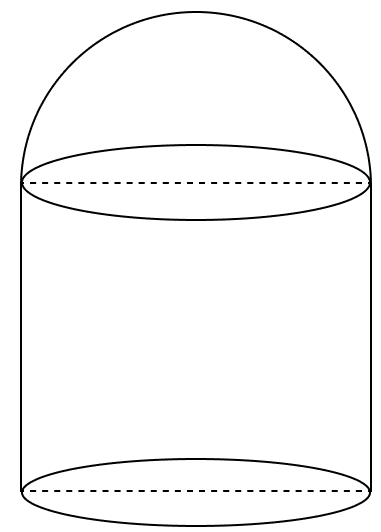
In the given figure, a metal container is in the form of a cylinder surmounted by a hemisphere. The internal height of the cylinder is 7 m and the internal radius is 3.5 m. Calculate:
(i) the total area of the internal surface, excluding the base.
(ii) the internal volume of the container in m3.
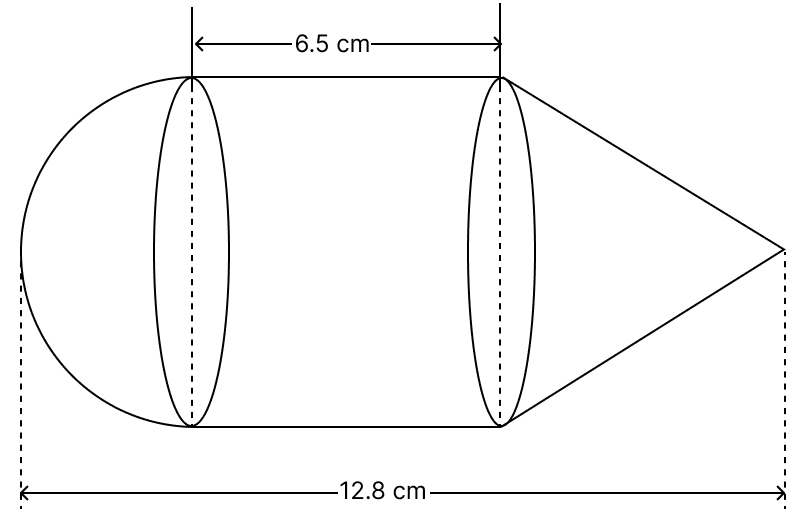
The adjoining figure represents a solid consisting of a cylinder surmounted by a cone at one end and a hemisphere at the other end. Given that, common radius = 3.5 cm, the height of the cylinder = 6.5 cm and the total height = 12.8 cm, calculate the volume of the solid, correct to the nearest integer.