
Mathematics
Solve graphically the following equations: x + 2y = 4, 3x - 2y = 4.
Take 2 cm = 1 unit on each axis. Write down the area of the triangle formed by the lines and the y-axis. Also, find the area of the triangle formed by the lines and the x-axis.
Coordinate Geometry
7 Likes
Answer
Given,
⇒ x + 2y = 4
⇒ 2y = 4 - x
⇒ y = ………………….(1)
When x = 0, y = = 2,
x = 2, y = = 1,
x = 4, y = = 0.
Table of values for equation (1)
| x | 0 | 2 | 4 |
|---|---|---|---|
| y | 2 | 1 | 0 |
Steps of construction :
Plot the points (0, 2), (2, 1) and (4, 0).
Join the points.
Given,
⇒ 3x - 2y = 4
⇒ 2y = 3x - 4
⇒ y = ………………(2)
When x = 0, y = = -2,
x = 2, y = = 1,
x = 4, y = = 4.
x = = 0.
Table of values for equation (2)
| x | 0 | 2 | 4 | |
|---|---|---|---|---|
| y | -2 | 1 | 4 | 0 |
Steps of construction :
Plot the points (0, -2), (2, 1), (4, 4) and .
Join the points.
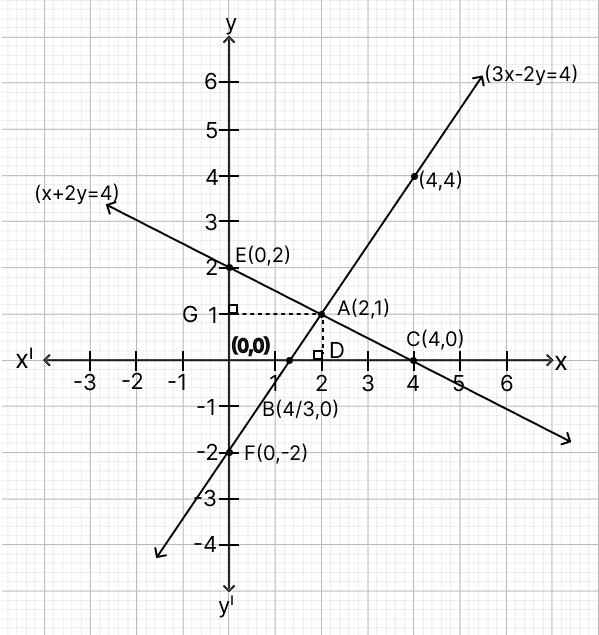
From graph,
A(2, 1) is the point of intersection of lines.
AEF is the triangle between lines and y-axis.
From A, draw AG perpendicular to EF.
Using distance formula, distance =
Distance between E (0, 2) and F (0, -2)
= units
From graph,
AG = 2 units
EF = 4 units
Area of triangle = x base x height
= x EF x AG
= x 4 x 2
= 1 x 4
= 4 sq. units.
And, ABC is the triangle between lines and x-axis.
Using distance formula, distance =
Distance between B and C (4, 0)
=
From A, draw AD perpendicular to BC.
AD = 1 unit
BC = units
Area of triangle = x base x height
Hence, point of intersection of lines is x = 2, y = 1 and area of the triangle formed by the lines and the y-axis = 4 sq. unit and area of the triangle formed by the lines and the x-axis = sq units.
Answered By
3 Likes
Related Questions
Use graph paper for this question :
(i) Draw the graphs of 3x - y - 2 = 0 and 2x + y - 8 = 0. Take 1 cm = 1 unit on both axes and plot three points per line.
(ii) Write down the coordinates of the point of intersection and the area of the triangle formed by the lines and the x-axis.
Solve the following system of linear equations graphically :
2x - y - 4 = 0, x + y + 1 = 0.
Hence, find the area of the triangle formed by these lines and the y-axis.
On graph paper, take 2 cm to represent one unit on both axes, draw the lines :
x + 3 = 0, y - 2 = 0, 2x + 3y = 12.
Write down the coordinates of the vertices of the triangle formed by these lines.
Find graphically the coordinates of the vertices of the triangle formed by the lines y = 0, y = x and 2x + 3y = 10. Hence, find the area of the triangle formed by these lines.