Commercial Applications
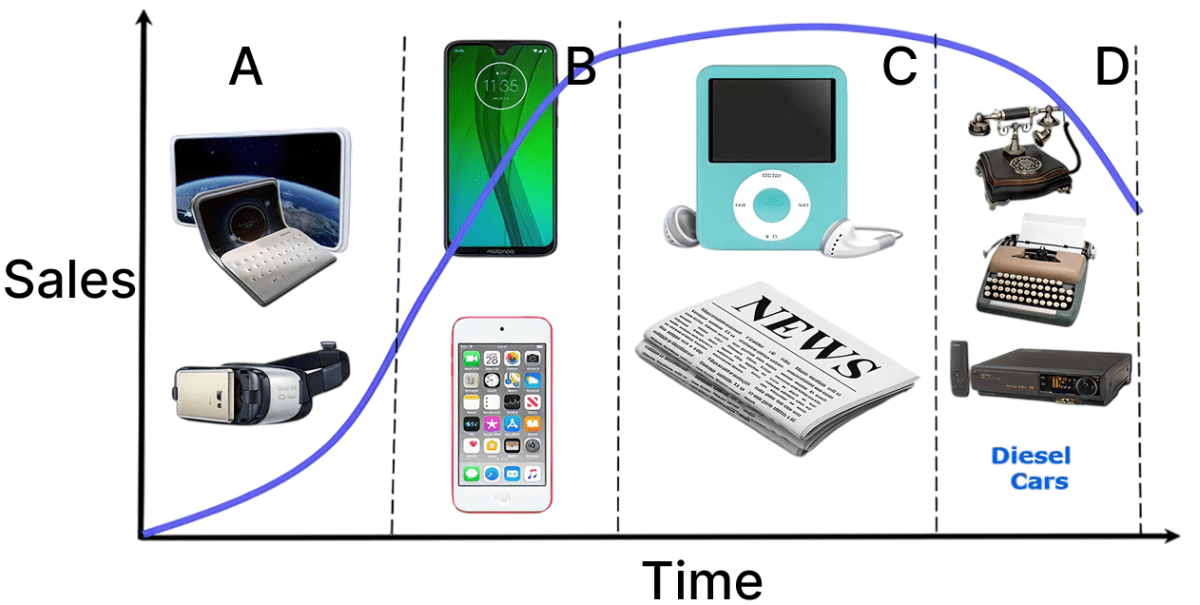
Which stage of the product life cycle is most likely represented by the products in "D category" in the image below?
- Introduction
- Growth
- Maturity
- Decline
Answer
Decline
Reason — In the product life cycle, the stages occur in the sequence: Introduction (A), Growth (B), Maturity (C), Decline (D), and Abandonment (E). The products shown in category D (such as obsolete items) are characterised by sharply falling sales and gradual displacement by new and superior products, which indicates the decline stage.
Related Questions
The usual source for new products is ……………
- Marketing research
- R&D
- Accidental discoveries
- A variety of sources including customers, competitors
A company launches a new product in the market with the following conditions:
(i) The product is priced significantly higher than competitors.
(ii) The target market is affluent consumers who value exclusivity.
(iii) The product is heavily promoted as a luxury item.
Which pricing strategy is the company likely using?
- Penetration Pricing
- Cost-Plus Pricing
- Skimming Pricing
- Parity Pricing
Assertion (A): The decline stage of the product life cycle is characterized by a decrease in sales and market share.
Reason (R): Companies should invest heavily in marketing and innovation during the decline stage to revive the product's growth.
- A is true but R is false
- A is false but R is true
- Both A and R are true and R explains A.
- Both A and R are true but R does not explain A.
In which stage of product life cycle, the company takes decision whether to maintain, harvest or drop the product?
- Introduction
- Growth
- Maturity
- Decline