
Physics
State the energy conversions taking place:
(a) during photosynthesis
(b) in a thermocouple
(c) during bursting a cracker
Work, Energy & Power
8 Likes
Answer
(a) Light energy → Chemical energy
Reason : During photosynthesis, the light energy from the Sun is absorbed by the green plants and they change it in the form of chemical energy (food).
(b) Heat energy → Electrical energy
Reason : In a thermocouple, when two junctions of two different metals are kept at different temperatures (one junction is kept hot, while the other cold), a current flows in the thermocouple. Thus, a thermocouple changes the heat energy supplied at the hot junction into electrical energy.
(c) Chemical energy → Heat energy + light energy + sound energy
Reason : In a cracker different chemicals in the presence of heat react with each other and it's stored chemical energy is rapidly released as heat, light, and sound.
Answered By
5 Likes
Related Questions
(a) Name the electromagnetic radiations which are used for sterilising water in a water purifier.
(b) State any one property of the radiations mentioned by you in part (a).
(c) Why are the danger signals red in colour?
A uniform metre ruler is balanced horizontally on a knife edge placed at 60 cm mark when a mass m is suspended from 75 cm mark. Draw the diagram of the arrangement. State with reason (through mathematical steps) whether the mass of the scale is greater than, less than or equal to the mass m?
An inclined plane makes an angle of 30° with the horizontal as shown in the figure. A box of mass 20 kg is taken from point A to point B along the inclined plane of length 2 m.
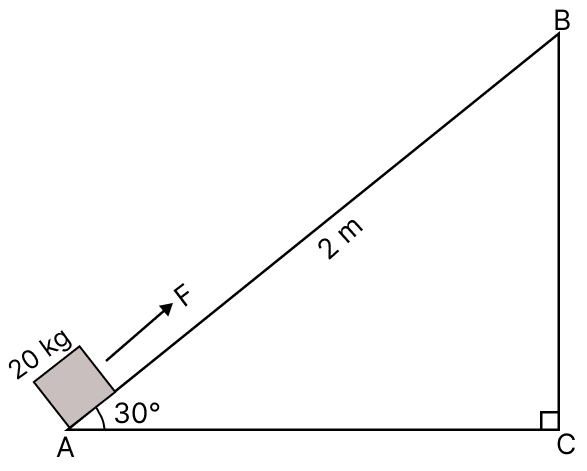
(a) Calculate the potential energy gained by the box.
(b) If 10 J of work is done against friction, in moving the box from A to B then calculate the force F needed to pull the block from A to B. [g = 10 m s-2]
The graph shows load against effort for a lever with load and effort on the same side of the fulcrum.
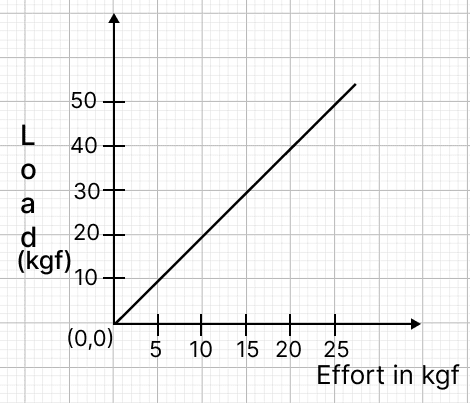
(a) Which attribute of the load vs effort graph must be calculated to determine the mechanical advantage?
(b) Which class does this lever belong to? How did you arrive at this conclusion?