
Chemistry
State one appropriate observation when :
(a) Copper sulphide is treated with dilute hydrochloric acid.
(b) A few drops of dil. HCl are added to AgNO3 solution. followed by addition of NH4OH solution.
(c) Lead nitrate solution is mixed with dilute hydrochloric acid and heated.
(d) A small piece of zinc is added to dilute hydrochloric acid.
(e) Dilute HCl is added to sodium carbonate crystals.
(f) Concentrated HCl is added to manganese dioxide.
Hydrogen Chloride
33 Likes
Answer
(a) A colourless gas having smell of rotten eggs is given off. The gas evolved is H2S
CuS + 2HCl ⟶ CuCl2 + H2S ↑
(b) Curdy white precipitate of silver chloride [AgCl] is obtained, which is soluble in excess of NH4OH.
AgNO3 + HCl ⟶ AgCl ↓ + HNO3
AgCl + 2NH4OH ⟶ [Ag(NH3)2Cl)] + 2H2O
(c) White precipitate of PbCl2 is formed which is soluble in hot water.
Pb(NO3)2 + 2HCl ⟶ PbCl2 ↓ + 2HNO3
(d) Hydrogen gas is evolved with bubbles and it burns with a pop sound
Zn + 2HCl ⟶ ZnCl2 + H2 ↑
(e) Effervescence of CO2 seen which turns lime water milky.
Na2CO3 + 2HCl ⟶ 2NaCl + H2O + CO2 ↑
(f) When concentrated hydrochloric acid is added to manganese dioxide (MnO2), a greenish-yellow gas (chlorine gas) is evolved with effervescence.
MnO2 + 4HCl (conc.) MnCl2 + 2H2O + Cl2↑
Answered By
24 Likes
Related Questions
Write the balanced equations for the reaction of dilute hydrochloric acid with each of the following:
(a) Iron
(b) Sodium hydrogen carbonate
(c) Iron (II) sulphide
(d) magnesium sulphite
How would you distinguish between dilute HCl and dilute HNO3, by addition of only one solution.
Distinguish by using HCl.
(a) Lead nitrate solution and silver nitrate solution.
(b) Potassium sulphite and potassium sulphide.
The given set up in the figure is for the preparation of an acid
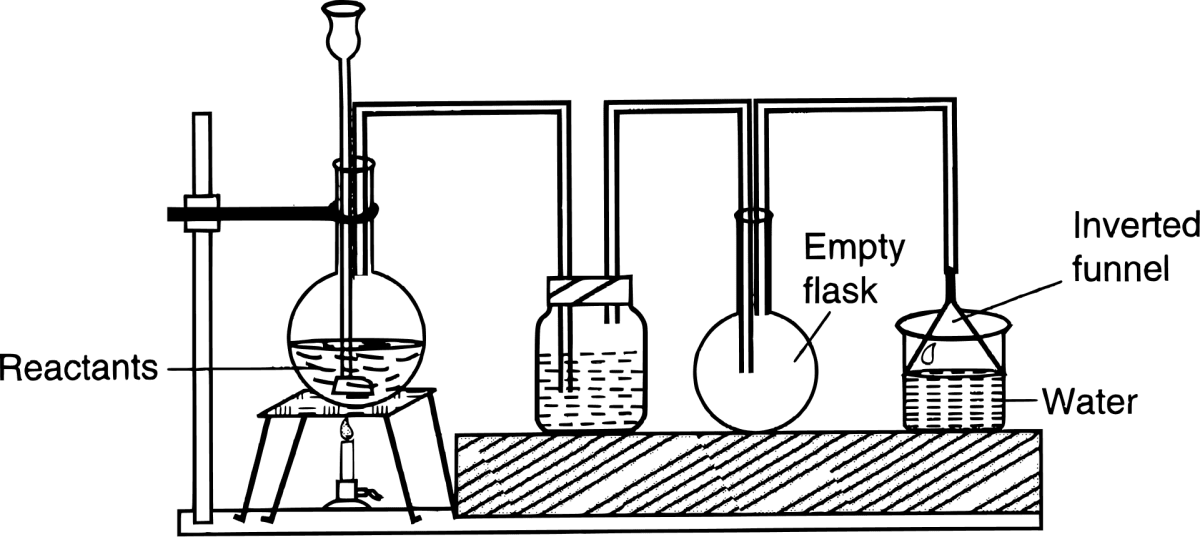
(a) Name the acid prepared by this method.
(b) Name the reactants used.
(c) Why an empty flask is used?
(d) What is the drying agent used? Why is this drying agent chosen
(e) What is the role of inverted funnel in the arrangement?