
History & Civics
State the role of Jawaharlal Nehru under the following heads:
(a) Vision in starting the NAM.
(b) Curbing the mad race for armaments.
(c) As the spokesman for the newly independent countries of Asia and Africa.
Non Aligned Movement
100 Likes
Answer
(a) India was the first country to initiate the policy of non-alignment, under the leadership of Nehru.
- Pt. Nehru was a visionary.
- He realised that the greatest danger to the sovereignty and integrity of India and the other newly independent nations of Asia and Africa lay in their joining any of the two power blocs.
- He called upon these countries to keep themselves away from the politics of two opposing camps, which had already brought about two world wars.
- He advocated mutual respect for the sovereignty and territorial integrity of all nations.
- It was Nehru, who gradually led the countries of Asia and Africa towards the concept of non-alignment.
- He convinced these countries that they had great moral force and with their collective efforts could exert pressure on the issues of war and peace.
- It was in confirmation of his views that he along with Josip Broz Tito of Yugoslavia, Gamal Abdel Nasser of Egypt, Chou En Lai of China, Ho Chi Minh of Vietnam and Kwame Nkrumah of Ghana led the Bandung Conference.
- The decisions taken at the Bandung Conference were given a final shape at Belgrade in 1956.
- Here, it was decided to form an organisation of the newly independent countries.
(b) Pt. Nehru was against the mad race for armaments.
- He called for disarmament and abolition of stockpiles of nuclear weapons.
- It was in pursuance of his policy of disarmament that India signed a treaty in 1963 for banning atomic tests.
(c) Nehru was acknowledged as the greatest spokesman for neutrality of Asian and African States in the Cold War era.
- Opposing the policy of alignment, Nehru said, "By aligning ourselves with any one power, you surrender your opinion, give up the policy you would normally pursue because somebody else wants you to pursue another policy. I do not think that it would be a right policy for us to adopt."
- Though Nehru was committed to western concept of liberalism and democracy, he did not approve of the military or economic alliances. He opposed these alliances as he believed that they encouraged colonialism and imperialism and were likely to produce a race for armaments.
- Nehru was against the philosophy advocated by the two power blocs.
- He was influenced by socialism. He therefore, strongly advocated the principles of democratic socialism.
- His policy of non-alignment was not meant to promote a third bloc, but to ensure freedom of decision-making of the recently decolonised states.
- Under the stewardship of Nehru, India played an important role in spreading the message of NAM. India promoted the cause of freedom of many countries of Asia and Africa which were still under foreign domination.
Answered By
51 Likes
Related Questions
What was Pt. Nehru's view about non-alignment? What did Pt. Nehru do to curb the mad race for armaments?
Read the excerpt given below and answer the questions that follow:
'Cruel Genocidal Act': Non-aligned Movement condemns Israel's assault on Gaza
The five-day summit of NAM member states which began on 15 January, 2024 was held in Uganda, where President Yoweri Museveni officially assumed the chairmanship of the summit and the NAM for the next three years.
The body "strongly condemn the illegal Israeli military aggression on the Gaza Strip, the indiscriminate attacks against Palestinian civilians, civilian objects, the forced displacement of the Palestinian population and further calls for an immediate and durable humanitarian ceasefire". It urged for the implementation of a UN Security Council resolution to allow humanitarian aid into the besieged strip.
The New Arab, January 21, 2024
(a) With reference to the above excerpt, state the relevance of NAM at present.
(b) Explain how Non-alignment is neither neutrality, nor isolation nor non-commitment.
(c) Give any four objectives of NAM.
Study the picture and answer the following questions:
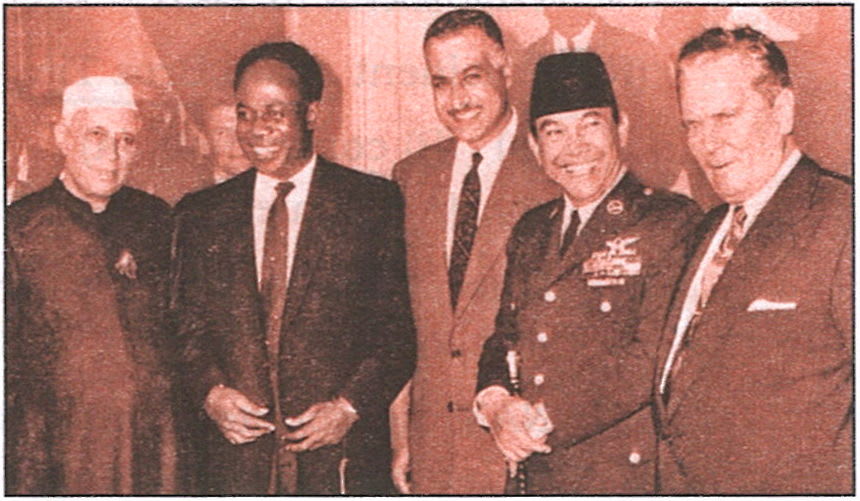
(a) Identify at least three persons in the picture. Name the organisation with which these persons were associated.
(b) Where was this organisation formed? State any three objectives of this organisation.
(c) Has this organisation been able to achieve its objectives? Give reasons for your answer.
State any three issues which can be taken up by NAM in its forthcoming summit.