
Chemistry
State the terms/process for the following:
(a) The energy released when an atom in the gaseous state accepts an electron to form an anion.
(b) Tendency of an element to form chains of identical atoms.
(c) The name of the process by which Ammonia is manufactured on a large scale.
(d) A type of salt formed by partial replacement of hydroxyl radicals with an acid radical.
(e) The ratio of the mass of a certain volume of gas to the same volume of hydrogen measured under the same conditions of temperature and pressure.
Periodic Table
ICSE 2023
49 Likes
Answer
(a) Electron affinity
(b) Catenation
(c) Haber’s process
(d) Basic salt
(e) Vapour Density
Answered By
28 Likes
Related Questions
The following sketch illustrates the process of conversion of Alumina to Aluminium:
Study the diagram and answer the following:
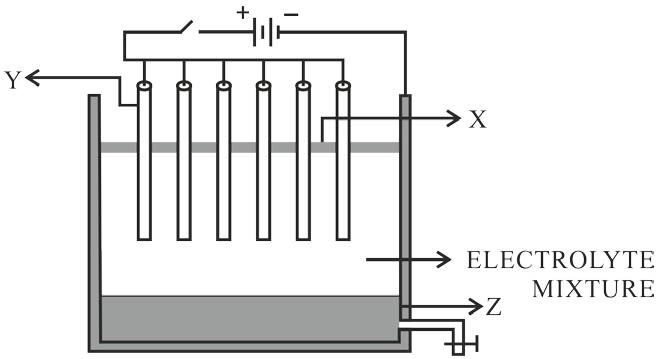
(a) Name the constituent of the electrolyte mixture which has a divalent metal in it.
(b) Name the powdered substance 'X' sprinkled on the surface of the electrolyte mixture.
(c) What is the name of the process?
(d) Write the reactions taking place at the electrodes 'Y' (anode) and 'Z' (cathode) respectively.
Fill in the blanks with the choices given in the brackets:
(a) Metals are good …………… [oxidizing agents / reducing agents]
(b) Non-polar covalent compounds are …………… [good / bad] conductors of heat and electricity.
(c) Higher the pH value of a solution, the more is …………… [acidic / alkaline] it is.
(d) …………… [Silver chloride / Lead chloride] is a white precipitate that is soluble in excess of Ammonium hydroxide solution.
(e) Conversion of ethene to ethane is an example of …………… . [hydration / hydrogenation]
(a) Give the structural formula of the following organic compounds:
- 2-chlorobutane
- Methanal
- But-2-yne
(b) Give the IUPAC name of the following organic compounds:

Identify the cation in each of the following cases:
(a) Ammonium hydroxide solution when added to Solution B gives a white precipitate which does not dissolve in excess of ammonium hydroxide solution.
(b) Sodium hydroxide solution when added to Solution C gives a white precipitate which is insoluble in excess of sodium hydroxide solution.