
Mathematics
State whether the following statements are true (T) or false (F):
(i) Centimetre is the unit of area.
(ii) The sum of lengths of a polygon is called its area.
(iii) If the side of a square is doubled, then its perimeter is also doubled.
(iv) If the side of a square is doubled, then its area is also doubled.
(v) To find the cost of constructing a road, we find its area.
(vi) To find the cost of fencing a field, we find its perimeter.
Mensuration
2 Likes
Answer
(i) False. Centimetre is the unit of length, not area. Area is measured in square centimetres (sq. cm).
(ii) False. The sum of lengths of the sides of a polygon is called its perimeter, not its area.
(iii) True. If side = s, then original perimeter = 4s. If side is doubled (i.e., 2s), then new perimeter = 4(2s) = 8s = 2 × 4s. So, perimeter is also doubled.
(iv) False. If side = s, then original area = s2. If side is doubled (i.e., 2s), then new area = (2s)2 = 4s2. So, area becomes four times, not double.
(v) True. Construction of a road covers its surface, so we find its area.
(vi) True. Fencing is done along the boundary, so we find the perimeter.
Answered By
3 Likes
Related Questions
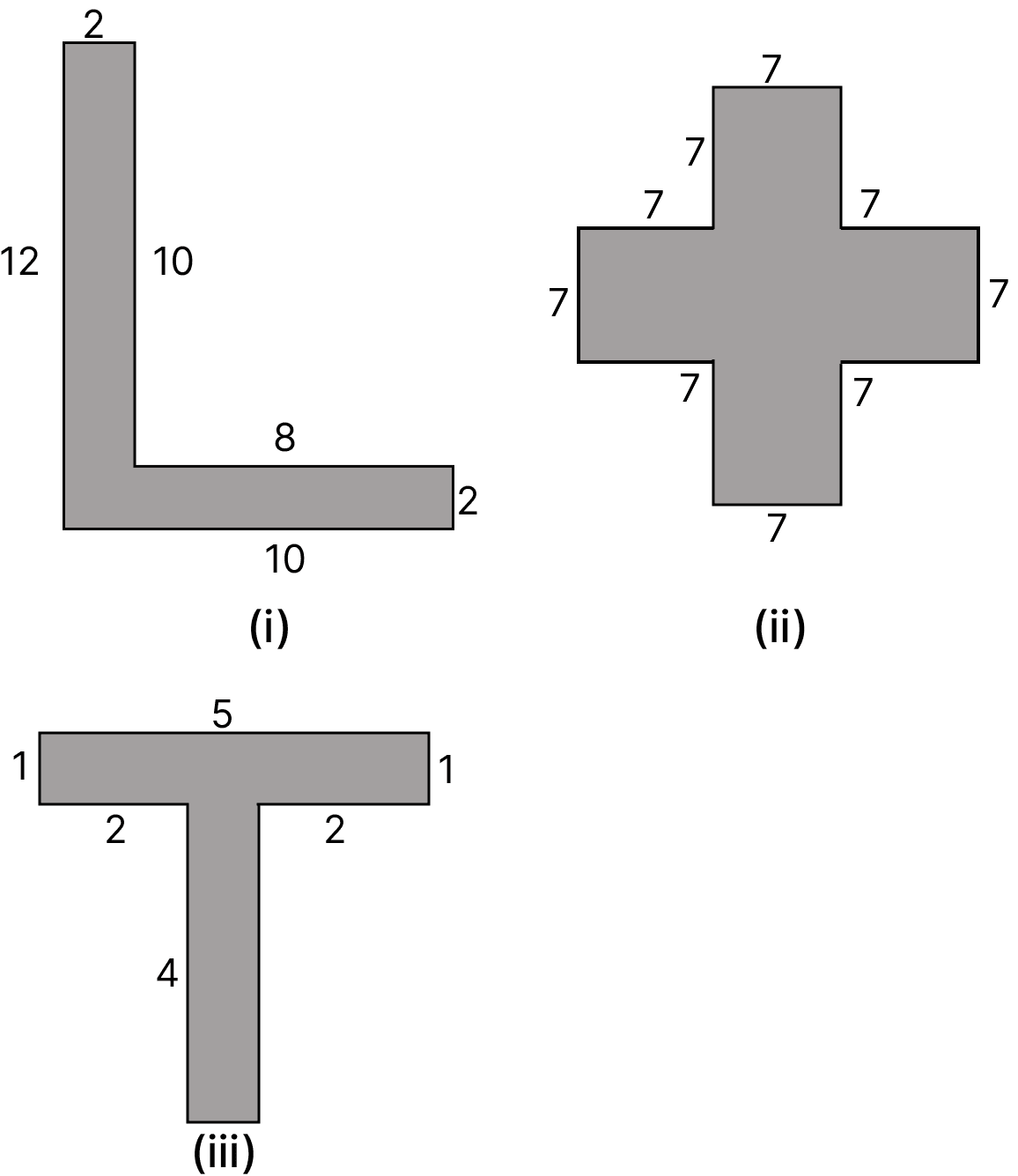
Split the following shapes into rectangles and find their areas. (The measures are given in centimetres):
Fill in the blanks:
(i) The perimeter of a closed plane figure is the length of its …..
(ii) The unit of measurement of perimeter is same as that of …..
(iii) If the side of a rhombus is 7 cm then its perimeter is …..
(iv) The area of a closed plane figure is measured in ……
If the perimeter of a square is 50 cm, then its side is
200 cm
150 cm
25 cm
12.5 cm
The area of the rectangle with length 25 cm and breadth 12 cm is
300 sq. m
74 cm
300 sq. cm
74 sq. cm