Mathematics
State whether the following statements are true (T) or false (F):
(i) If a number is divisible by 4, it must be divisible by 8.
(ii) If a number is divisible by 3, it must be divisible by 9.
(iii) If a number is divisible by 9, it must be divisible by 3.
(iv) If a number is divisible by 9 and 10 both, it must be divisible by 90.
(v) If a number divides the sum of two numbers, then it must divide the two numbers separately.
(vi) If a number is divisible by 3 and 8 both, it must be divisible by 12.
(vii) If a number is divisible by 6 and 15 both, it must be divisible by 90.
Answer
(i) False.
Reason: For example, 12 is divisible by 4 but not by 8.
(ii) False.
Reason: For example, 6 is divisible by 3 but not by 9.
(iii) True.
Reason: Since 3 is a factor of 9, every number divisible by 9 is also divisible by 3.
(iv) True.
Reason: 9 and 10 are co-prime, so any number divisible by both is divisible by 9 × 10 = 90.
(v) False.
Reason: For example, 5 divides the sum 3 + 7 = 10, but 5 does not divide 3 or 7 separately.
(vi) True.
Reason: Since 3 and 8 are co-prime, the number is divisible by 3 × 8 = 24, and 12 is a factor of 24, so the number is divisible by 12 as well.
(vii) False.
Reason: 6 and 15 are not co-prime (HCF = 3). The LCM of 6 and 15 is 30. For example, 30 is divisible by both 6 and 15 but not by 90.
Related Questions
A number is divisible by 12. By what other numbers will that number be divisible?
A number is divisible by both 3 and 8. By which other numbers will that number be always divisible?
Here are two different factor trees of the number 90. Write the missing numbers:
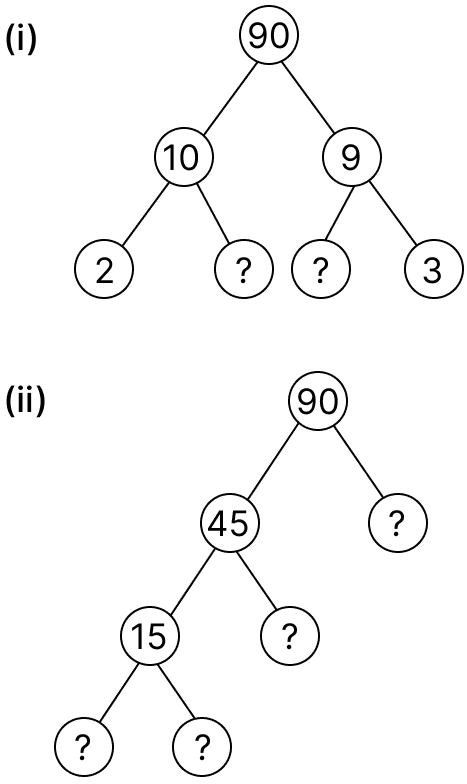
Find the prime factorisation of the following numbers:
(i) 72
(ii) 172
(iii) 450
(iv) 980
(v) 8712
(vi) 13500