
Mathematics
State whether the following statements are true (T) or false (F):
(i) The successor of a one-digit number is always a one-digit number.
(ii) The predecessor of every two-digit number is a one-digit number.
(iii) The predecessor of a 3-digit number is always a 3-digit number.
(iv) The successor of a 3-digit number is always a 3-digit number.
(v) If a is any whole number, then a ÷ a = 1
(vi) If a is any non-zero whole number, then 0 ÷ a = 0
(vii) On adding two different whole numbers, we always get a natural number.
(viii) Between two whole numbers there is a whole number.
(ix) There is a natural number which when added to a natural number, gives that number.
(x) If the product of two whole numbers is zero, then at least one of them is zero.
(xi) Any non-zero whole number divided by itself gives the quotient 1.
Whole Numbers
3 Likes
Answer
(i) False.
Reason: The successor of 9 (a one-digit number) is 10, which is a two-digit number.
(ii) False.
Reason: The predecessor of 99 (a two-digit number) is 98, which is also a two-digit number.
(iii) False.
Reason: The predecessor of 100 (a 3-digit number) is 99, which is a 2-digit number.
(iv) False.
Reason: The successor of 999 (a 3-digit number) is 1000, which is a 4-digit number.
(v) False.
Reason: If a = 0, then a ÷ a = 0 ÷ 0 is not defined. So, the statement is not true for all whole numbers.
(vi) True.
Reason: Zero divided by any non-zero whole number is always 0. For example, 0 ÷ 5 = 0.
(vii) True.
Reason: When two different whole numbers are added, at least one of them is non-zero. So, the sum is at least 1, which is a natural number.
(viii) False.
Reason: Between two consecutive whole numbers (such as 5 and 6), there is no whole number.
(ix) False.
Reason: The number 0, when added to any natural number, gives that number. But 0 is not a natural number. There is no natural number that acts as the additive identity for natural numbers.
(x) True.
Reason: If a × b = 0, then either a = 0 or b = 0 (or both).
(xi) True.
Reason: Any non-zero whole number a satisfies a ÷ a = 1, since a × 1 = a.
Answered By
3 Likes
Related Questions
Look at the following figures made up of dots:
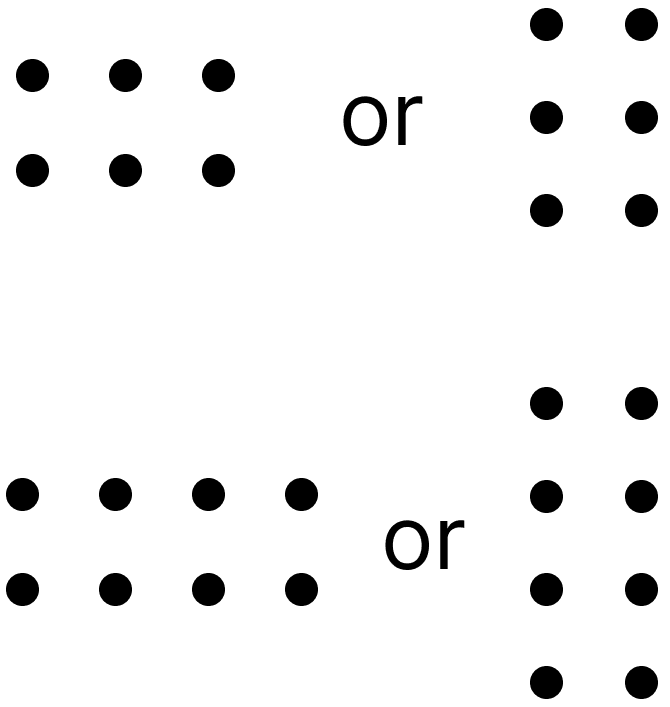
These figures show the arrangement of the numbers 2 × 3 or 3 × 2; 2 × 4 or 4 × 2 i.e. the numbers 6 and 8.
The numbers 6 and 8 are called rectangular numbers. Can you write two more rectangular numbers?
Fill in the blanks:
(i) A whole number is less than all those whole numbers that lie to its …. on the number line.
(ii) One more than a given whole is called its ….
(iii) There is at least one whole number between two …. whole numbers.
(iv) 738 × 335 = 738 × (300 + 30 + ….)
(v) If a is a non-zero whole number and a × a = a, then a = ….
(vi) …. is the only whole number which is not a natural number.
(vii) The additive identity in whole numbers is ….
(viii) …. is the successor of the largest 3-digit number.
(ix) Division of a whole number by …. is not defined.
The whole number which does not have a predecessor in whole number system is
0
1
2
none of these
The predecessor of the smallest 4-digit number is
99
999
1000
1001