Mathematics
State whether the following statements are true or false:
(i) A rectangle is a regular quadrilateral.
(ii) A rhombus is a regular quadrilateral.
(iii) Every parallelogram is a rhombus.
(iv) The diagonals of a rhombus intersect at right angles.
(v) A polygon having 6 sides is called an octagon.
(vi) A road roller has two plane circular faces and one curved face.
(vii) A rectangular pyramid has 5 rectangular faces.
Answer
(i) False
Reason — A regular quadrilateral has all sides equal and all angles equal. A rectangle has all angles equal (90° each) but not all sides equal. So a rectangle is not a regular quadrilateral.
(ii) False
Reason — A rhombus has all sides equal but its angles are not necessarily equal. So a rhombus is not a regular quadrilateral.
(iii) False
Reason — A parallelogram has both pairs of opposite sides equal but not all sides equal in general. A rhombus has all four sides equal. So every parallelogram is not a rhombus.
(iv) True
Reason — The diagonals of a rhombus always intersect each other at right angles.
(v) False
Reason — A polygon with 6 sides is called a hexagon, not an octagon. An octagon has 8 sides.
(vi) True
Reason — A road roller is in the shape of a cylinder, which has two plane circular faces and one curved face.
(vii) False
Reason — A rectangular pyramid has 1 rectangular base and 4 triangular faces, making 5 faces in total. Only 1 face is rectangular, not all 5.
Related Questions
Name the types of the following triangles:
(i) ΔABC with AB = 8 cm, AC = 7 cm and BC = 5.5 cm.
(ii) ΔPQR with PQ = RP = 5 cm and QR = 7.3 cm.
(iii) ΔDEF with ∠D = 90°.
(iv) ΔXYZ with ∠Y = 90° and XY = YZ.
(v) ΔLMN with ∠L = 30°, ∠M = 70° and ∠N = 80°.
Name each of the following triangles in two different ways (you may use ruler and protractor):
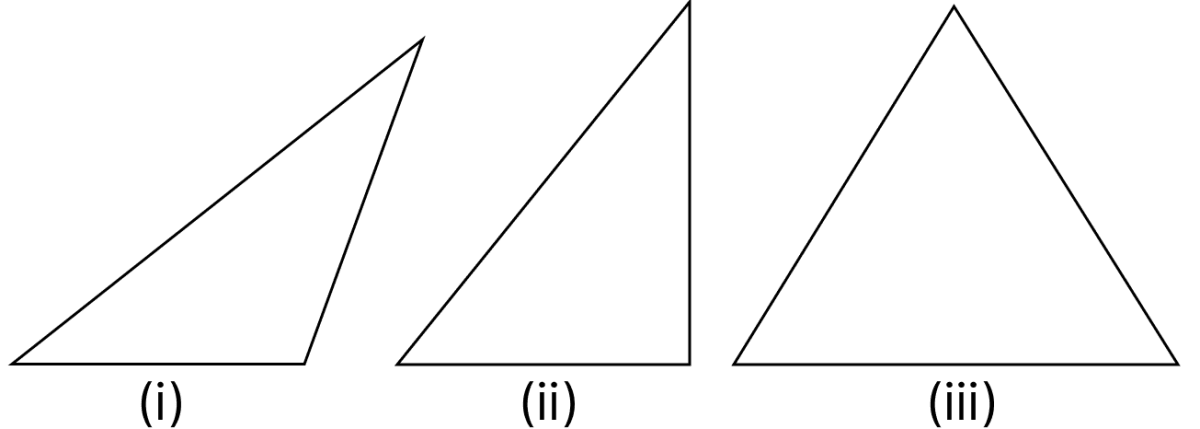
If the lengths of two sides of an isosceles triangle are 3 cm and 7 cm, then what is the length of the third side?
If the lengths of three consecutive sides of an isosceles trapezium are 5 cm, 6 cm and 8 cm, then what is the length of the fourth side?