Biology
State whether the following statements are true (T) or false (F):
(a) All animal cells contain a cell wall.
(b) The cell wall is made of protein.
(c) Centrosome occurs in animal cells.
(d) Plant cells contain large vacuoles.
(e) Protoplasm is the part of the cell which surrounds the nucleus.
(f) Genes are located in chromosomes.
(g) Anthocyanin are the pigments of flowers, which are dissolved in cell-sap.
Answer
(a) False
Corrected statement — All plant cells contain a cell wall.
(b) False
Corrected statement — The cell wall is made of cellulose.
(c) True
(d) True
(e) False
Corrected statement — Cytoplasm is the part of the cell which surrounds the nucleus.
(f) True
(g) False
Corrected statement — Anthocyanin are the pigments of fruits, which are dissolved in cell-sap.
Related Questions
Given below is the structure of nucleus of a cell. Read the information below the diagram and fill in the blanks:
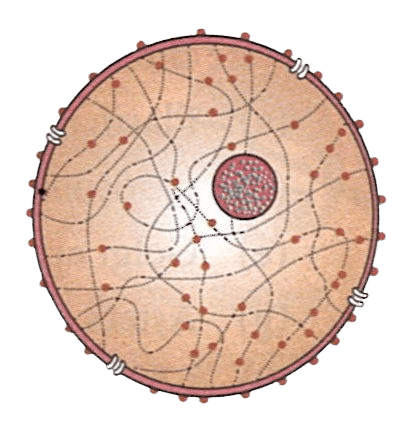
Nucleus is the most important part of the cell. It is located in the central area in animal cells but pushed towards the periphery in plant cells due to the presence of a large vacuole in the centre. It regulates and coordinates various life processes of the cell and also plays an important role in cell division.
Nucleus has a delicate, protective surrounding layer (a) …………… which is filled with a relatively dense fluid (b) …………… . There are certain thread-like structures suspended in the fluid called (c) …………… . These thin thread-like fine structures become thick and ribbon-like during the time of cell division. These prominent ribbon-like structures are called (d) …………… .Nucleus contains a spherical, dense body inside it, called as (e) …………… which participates in protein synthesis.
Name the part of the cell concerned with the following?
- Liberation of energy
- Synthesis of proteins
- Transmission of heredity characters from parents to offspring
- Initiation of cell division
- Hydrolytic in function
- Entry of only certain substances into and out of the cell.
How many chromosome pairs are found in human cells?
What is the name of the chemical substance which constitutes the genes?