Mathematics
Statement 1: O and O' are centres of two equal circles and ABCD is a straight line.
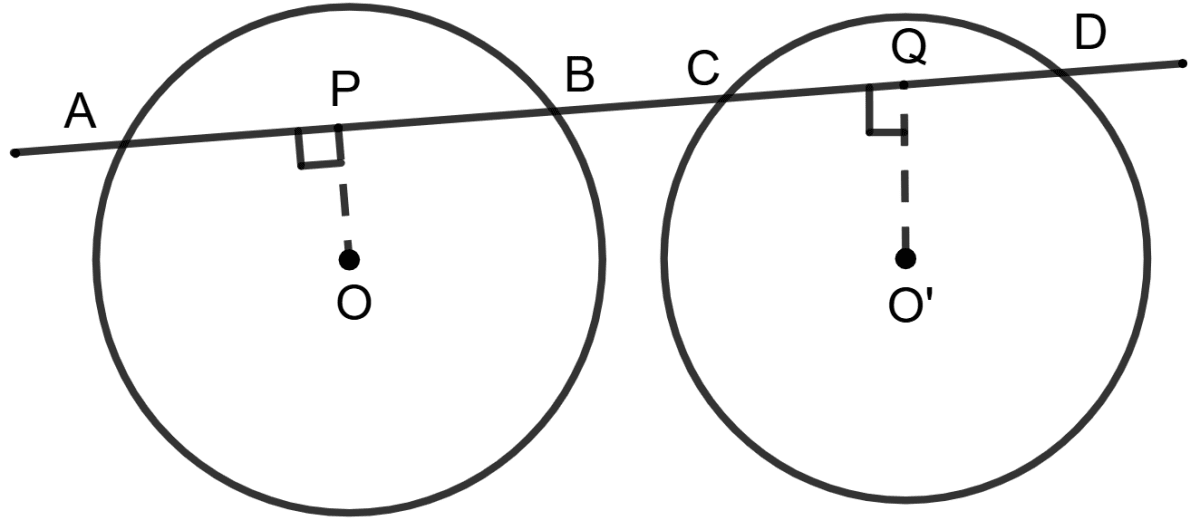
Statement 2: If OP ⊥ AB, O'Q ⊥ CD and O'Q is greater than OP, then CD > AB.
Both the statements are true.
Both the statements are false.
Statement 1 is true, and statement 2 is false.
Statement 1 is false, and statement 2 is true.
Answer
O and O' are centres of two equal circles means they are having same radius.
The points A, B, C and D are shown aligned horizontally forming a single, continuous line.
∴ Statement 1 is true.
According to fundamental property of a circle, in two same circles, the chord that is farther from the center is shorter, and the chord that is closer to the center is longer.
Given, OP ⊥ AB, O'Q ⊥ CD and O'Q > OP.
⇒ CD < AB
∴ Statement 2 is false.
∴ Statement 1 is true, and statement 2 is false.
Hence, option 3 is the correct option.
Related Questions
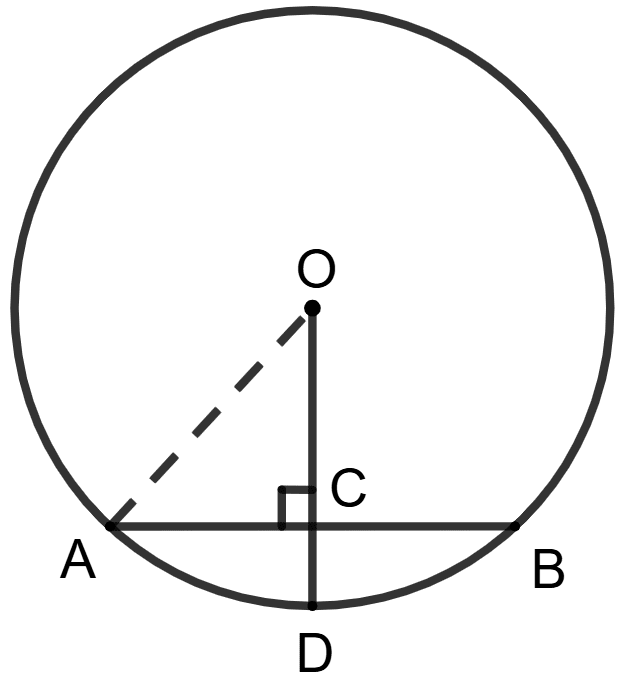
Given O is center of the circle with chord AB = 8 cm, OA = 5 cm and OD ⊥ AB. The length of CD is :
3 cm
5 cm
2 cm
none of these
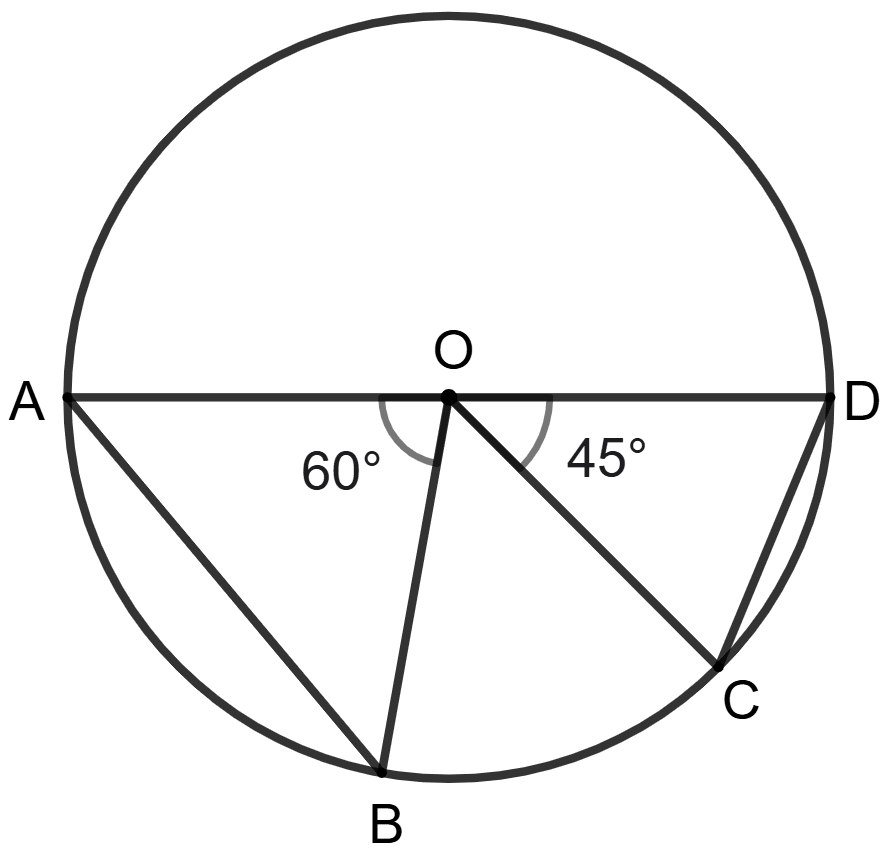
AB and CD are the chords of a circle with centre O, ∠AOB = 60° and angles ∠COD = 45°; the ratio between the length of the chords AB and CD is
3 : 4
4 : 3
7 : 4
7 : 3
Statement 1: In a circle with center O, chord AB : chord BC = 1 : 3. If angle AOC is 160° ⇒ angle BOC = 120°.
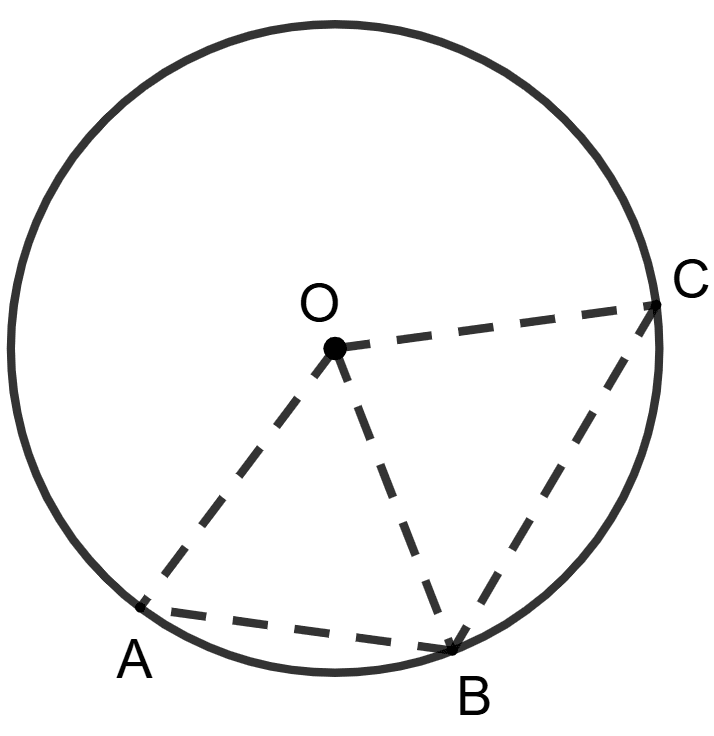
Statement 2: AB : BC = 1 : 3
⇒ ∠AOC = 3 x ∠AOB
Both the statements are true.
Both the statements are false.
Statement 1 is true, and statement 2 is false.
Statement 1 is false, and statement 2 is true.