
Mathematics
Statement I: The value of the expression 4y + 3x when x = 2 and y = 3 is 22.
Statement II: An expression is a combination of terms connected by mathematical operations of addition, subtraction or both.
Statement I is true but statement II is false.
Statement I is false but statement II is true.
Both Statement I and statement II are true.
Both Statement I and statement II are false.
Algebra Basics
3 Likes
Answer
Statement I: Substituting x = 2 and y = 3 in 4y + 3x:
= 4(3) + 3(2)
= 12 + 6
= 18
The value of the expression is 18, not 22. Hence, Statement I is false.
Statement II: By definition, an algebraic expression is a combination of terms connected by mathematical operations such as addition or subtraction. Hence, Statement II is true.
Hence, option 2 is the correct option.
Answered By
2 Likes
Related Questions
Statement I: The number of terms in the expression x + 2y + y is 3.
Statement II: 3x + 4 = 0 is a linear equation.
Statement I is true but statement II is false.
Statement I is false but statement II is true.
Both Statement I and statement II are true.
Both Statement I and statement II are false.
Statement I: If John's present age is x years, then five less than double his age is (2x − 5) years.
Statement II: 3x × 4y is an algebraic expression with only one term.
Statement I is true but statement II is false.
Statement I is false but statement II is true.
Both Statement I and statement II are true.
Both Statement I and statement II are false.
Look at the following matchstick pattern of polygons. Complete the table. Also write the general rule that gives the number of matchsticks.
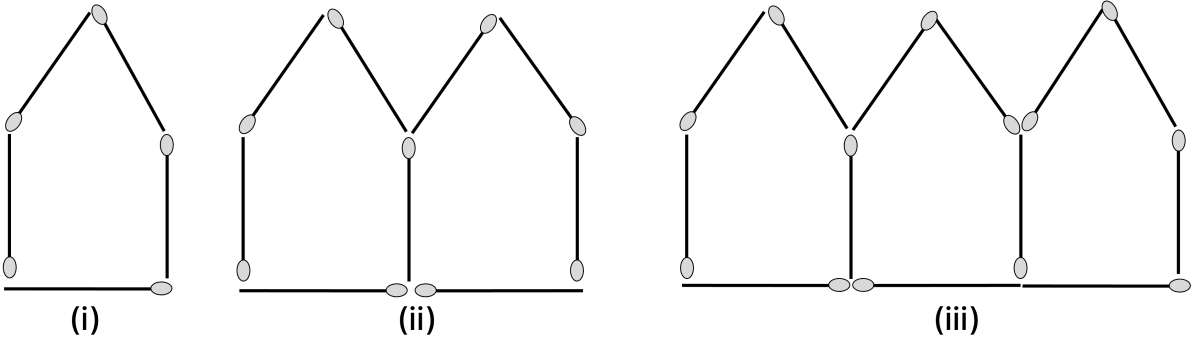
Number of polygons 1 2 3 4 5 … n Number of matchsticks … … … … … … … Consider the expression
(i) How many terms are there? What do you call such an expression?
(ii) List out the terms.
(iii) In the term , write down the numerical coefficient and the literal coefficient.
(iv) In the term , what is the coefficient of x?