
Biology
Study the diagrams given below and answer the following questions.

(a) Name the structures shown as X and Y in the figures (A) and (B), respectively.
(b) Write the functions performed by the structures X and Y.
(c) Name the phenomenon depicted and define it.
(d) How do the structures X and Y differ from each other?
(e) Give examples of the plants which show the said phenomenon.
Chemical Coordination in Plants
353 Likes
Answer
(a) X → Stem tendrils, Y → Leaf tendrils.
(b) Stem tendrils (X) and leaf tendrils (Y) enable the plant to climb up a support.
(c) Thigmotropism is the phenomenon depicted. It is the growth movement of plant parts in response to touch stimulus.
(d) Stem tendrils (X) arise from the stem while leaf tendrils (Y) arise from the leaf of the plant.
(e) Sweet Pea, Vines and Cuscuta.
Answered By
246 Likes
Related Questions
The figure given below shows the stages of ripening in a banana. Answer the questions that follow:

(a) Name the plant hormone responsible for the above changes.
(b) Mention two characteristic features of this hormone.
The diagram given alongside shows a type of tropism. Study the same and answer the questions that follow:

(a) Name and define the type of tropism shown in the diagram.
(b) Label the guidelines (1) to (4).
(c) Name two effective stimulants that help in the growth of part (2).
(d) Name two groups of plants where part (2) grows towards gametophyte with the help of the stimulants mentioned in (c).
Given below are the figures showing some kinds of tropic movements in plants. Study the same and answer the following questions:
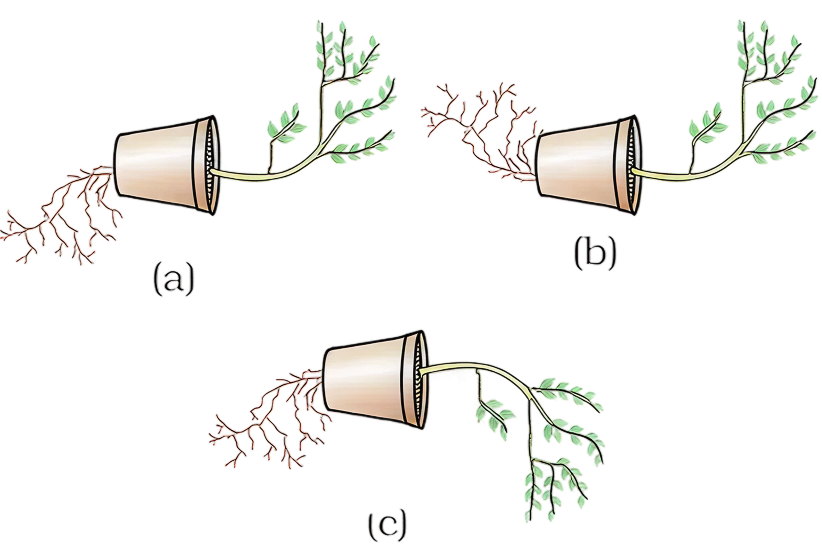
(a) Which one of these figures is correct? Give reason in support of your answer.
(b) Name the kind of movements shown by the root system and the shoot system. Define each.
(c) What are the two stimuli which affect root system and shoot system positively ? Name them.
(d) Which of the following stimuli affect the growth of root strongly?
- Gravity
- Water
(e) Draw a neat and labelled diagram of the longitudinal section of a pistil showing chemotropism in an angiospermic plant.
The figure given below depicts a kind of tropic movement in plants. Study the same and answer the following questions.

(a) What kind of a movement is shown in figure. Define it.
(b) How does this movement differ from geotropism?
(c) Name the stimulus responsible for thigmotropism. Give one example of a plant showing thigmotropism.
(d) Name one stimulus which gives a positive response for the roots but negative response for the shoot.
(e) Draw a neat and labelled diagram of the part of plant showing leaf tendril. Name the plant.