
Chemistry
Sulphuric acid is manufactured by contact process.
(a) Give two balanced equations to obtain SO2 in this process.
(b) Give the conditions for the oxidation of SO2.
(c) Name the catalyst used.
(d) Why H2SO4 is not obtained by directly reacting SO3 with water?
(e) Name the chemical used to dissolve SO3 and also name the product formed. Give all the main reactions of this process.
Sulphuric Acid
49 Likes
Answer
(a) 4FeS2 (iron pyrite) + 11O2 ⟶ 2Fe2O3 + 8SO2 ↑
S + O ⟶ SO2 ↑
(b) The conditions for the oxidation of SO2 are:
- The temperature should be as low as possible. The yield has been found to be maximum at about 410 ⁰C – 450 ⁰C.
- High pressure favours the reaction because the product formed has less volume than reactant. Pressure : 1 to 2 atmosphere.
- Excess of oxygen increases the production of sulphur trioxide.
(c) Vanadium pentoxide [V2O5]
(d) Sulphuric acid is not obtained by directly reacting SO3 with water since sulphur trioxide does not dissolve in water satisfactorily and it gives a lot of heat and forms misty droplets of sulphuric acid.
(e) The chemical used to dissolve SO3 is concentrated sulphuric acid and the product formed is oleum.
Main reactions of this process are:
SO3 + H2SO4 (conc.) ⟶ H2S2O7 (oleum)
H2S2O7 + H2O ⟶ 2H2SO4
Answered By
32 Likes
Related Questions
Comment, sulphuric acid is referred to as:
(a) King of chemicals
(b) Oil of Vitriol
Why the impurity of arsenic oxide must be removed before passing the mixture of SO2 and air through the catalytic chamber?
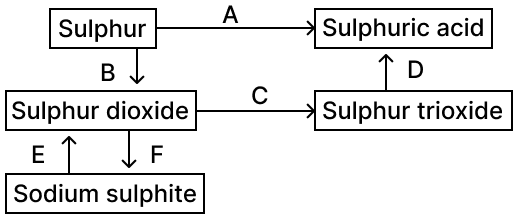
(a) Name the catalyst which helps in the conversion of sulphur dioxide to sulphur trioxide in step C.
(b) In the Contact process for the manufacture of sulphuric acid, sulphur trioxide is not converted to sulphuric acid by reacting it with water. Instead a two steps procedure is used. Write the equations for the two steps involved in D.
(c) What type of substance will liberate sulphur dioxide from sodium sulphite in step E?
(d) Write the equation for the reaction by which sulphur dioxide is converted to sodium sulphite in step F.
The gas evolved when dil. sulphuric acid reacts with iron sulphide.
- Hydrogen sulphide
- Sulphur dioxide
- Sulphur trioxide
- Vapour of sulphuric acid.