Commercial Applications
Answer
The statement is correct. The term 'cost' has different meanings in different contexts, and therefore it must always be qualified to convey precisely what is meant.
1. Common usage — In ordinary conversation, cost simply means the price paid for something or the sacrifice made to acquire something. For example, if a book is purchased for ₹100, the cost of the book to the buyer is ₹100.
2. Management terminology — In management accounting, cost means the expenditure incurred to generate revenue — that is, the money value of resources used to produce a product or provide a service. For example, if a publisher spends ₹80 to produce one copy of a book, the cost to the publisher is ₹80 (not ₹100, the price the customer pays).
3. Cost vs Loss vs Revenue — These three terms are often confused.
- Suppose a firm purchases a machine for ₹10,000 (asset value).
- It earns ₹1,000 with the help of the machine — this is revenue.
- The machine depreciates by ₹750 — this is cost.
- At year-end, the machine's book value is ₹9,250 (₹10,000 − ₹750), but if it is sold for only ₹9,000, the difference of ₹250 is loss.
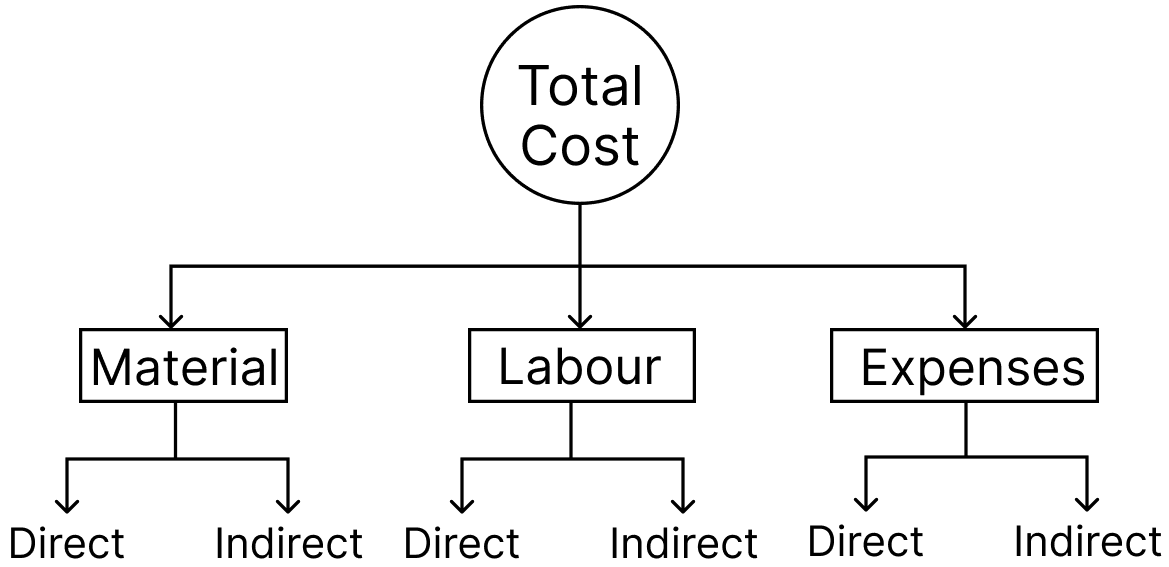
4. Different cost classifications — Cost can be classified in multiple ways:
- By element: material, labour, expenses
- By nature: direct cost, indirect cost
- By behaviour: fixed, variable, semi-variable