
Mathematics
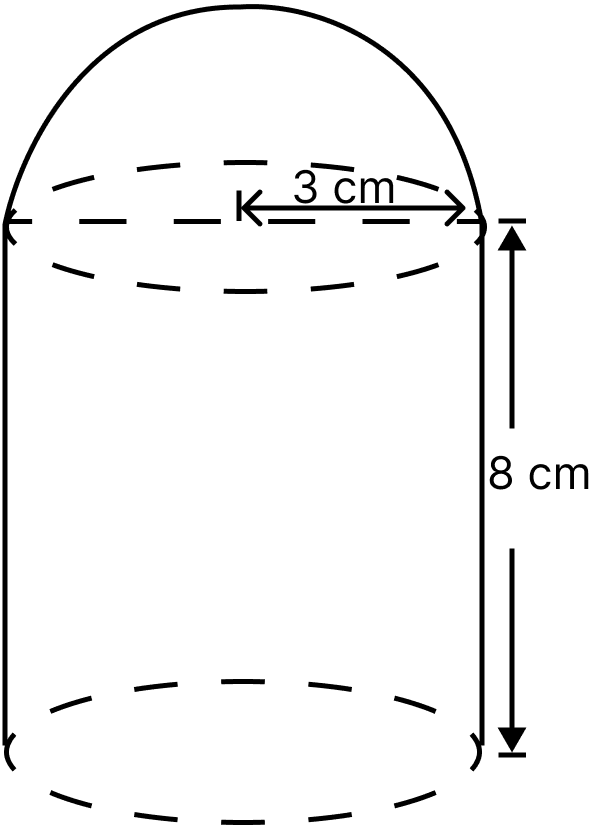
The adjoining figure shows a model of a solid consisting of a cylinder surmounted by a hemisphere at one end. If the model is drawn to a scale of 1 : 200, find
(i) the total surface area of the solid in π m2.
(ii) the volume of the solid in π litres.
Mensuration
103 Likes
Answer
(i) In the given figure,
Height of cylindrical portion (H) = 8 cm.
Radius of cylindrical portion = radius of hemispherical portion = (r) = 3 cm.
Scale = 1 : 200
∴ k = 200.
Total surface area (S) = Curved surface area of hemisphere + Curved surface area of cylinder + Area of base of cylinder
= 2πr2 + 2πrH + πr2
= 3πr2 + 2πrH
= πr(3r + 2H)
= 3π(3 × 3 + 2 × 8)
= 3π(9 + 16)
= 3π × 25
= 75π cm2.
∴ Surface area of solid = 75π × k2
= 75π × (200)2
= 75π × 40000 cm2
= 75π × m2
= 300π m2.
Hence, the surface area of solid = 300π m2.
(ii) Volume (V) = Volume of hemisphere + Volume of cylinder
= .
Substituting values we get :
∴ Volume of solid = 90π × k3
= 90π × (200)3
= 90π × 8000000
= 720000000π cm3
= m3
= 720π m3.
As, 1 m3 = 1000 litres
∴ Volume of solid = 720π × 1000 = 720000π litres.
Hence, the volume of solid = 720000π litres.
Answered By
61 Likes
Related Questions
A solid is in the form of a right circular cylinder with a hemisphere at one end and a cone at the other end. Their common diameter is 3.5 cm and the height of the cylindrical and conical portions are 10 cm and 6 cm respectively. Find the volume of the solid. (Take π = 3.14)
A toy is in the shape of a right circular cylinder with a hemisphere on one end and a cone on the other. The height and radius of the cylindrical part are 13 cm and 5 cm respectively. The radii of the hemispherical and conical parts are the same as that of the cylindrical part. Calculate the surface area of the toy if the height of the conical part is 12 cm.
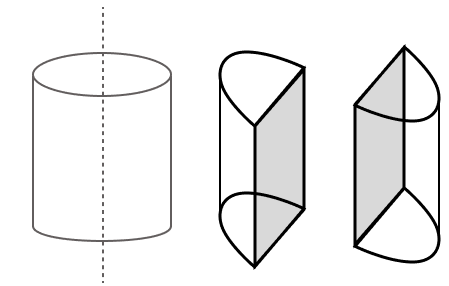
A solid metallic cylinder is cut into two identical halves along its height. The diameter of the cylinder is 7 cm and the height is 10 cm. Find :
(a) The total surface area (both the halves).
(b) The total cost of painting the two halves at the rate of ₹ 30 per cm2.
Oil is stored in a spherical vessel occupying of its full capacity. Radius of this spherical vessel is 28 cm. This oil is then poured into a cylindrical vessel with a radius of 21 cm. Find the height of the oil in the cylindrical vessel (correct to the nearest cm).
Take
