
Physics
The centre of gravity of a body is the point about which the algebraic sum of moments of weights of all the particles constituting the body is:
- 1
- > 1
- < 1
- 0
Force
29 Likes
Answer
0
Reason — The centre of gravity of a body is the point about which the algebraic sum of moments of weights of all the particles constituting the body is zero. This is because the center of gravity is chosen in such a way that the torques (moments) due to the weight of the individual particles balance out, resulting in a net torque of zero.
Answered By
16 Likes
Related Questions
A uniform metre rule of mass 100 g is balanced on a fulcrum at mark 40 cm by suspending an unknown mass m at the mark 20 cm.
(i) Find the value of m.
(ii) To which side the rule will tilt if the mass m is moved to the mark 10 cm?
(iii) What is the resultant moment now?
(iv) How can it be balanced by another mass 50 g?
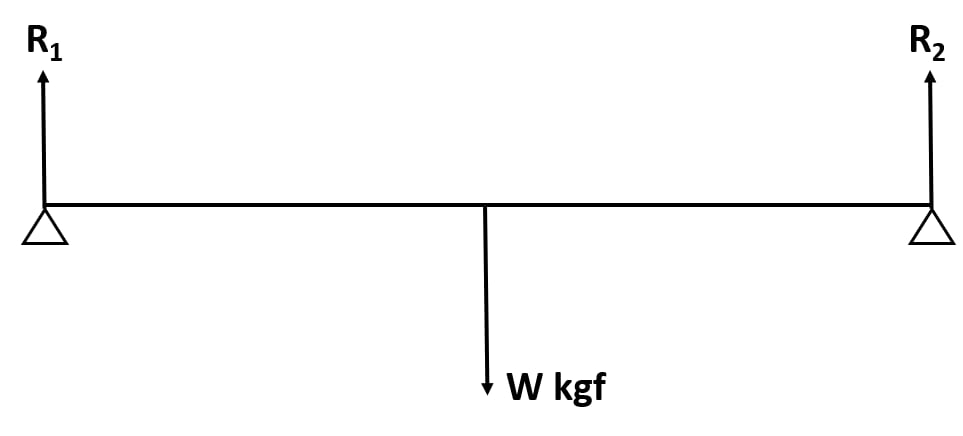
In figure below, a uniform bar of length l m is supported at its ends and loaded by a weight W kgf at its middle. In equilibrium, find the reactions R1 and R2 at the ends.
The centre of gravity of a hollow cone of height h is at distance x from its vertex where the value of x is:
Where should the centre of gravity of a body be located for stable equilibrium?
- above the base
- near the geometric centre
- can be anywhere
- both (1) and (2)