
Physics
The diagram below shows the use of a lever.
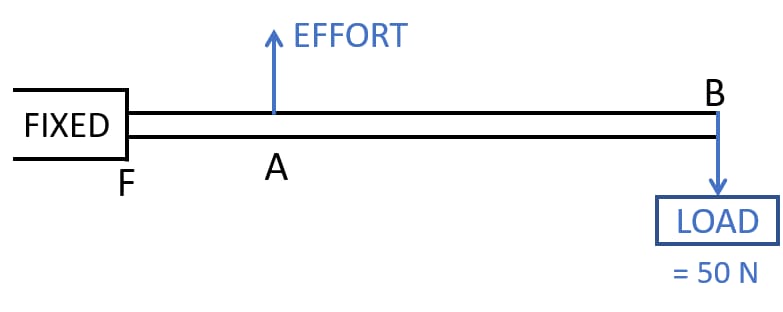
(a) State the principle of moments as applied to the above lever.
(b) To which class of lever does it belong? Give an example of this class of lever.
(c) If FA = 10 cm, AB = 490 cm,
calculate:
(i) the mechanical advantage, and
(ii) the minimum effort required to lift the load (= 50N).
Machines
120 Likes
Answer
(a) The principle of moments states that —
Moment of the load about the fulcrum = Moment of the effort about the fulcrum
(b) The above diagram belongs to Class III lever. The example of Class III lever is a sugar tongs.
(c)
(i) We know that,
Given,
Load arm = 490 cm + 10 cm = 500 cm
Effort arm = 10 cm
Substituting the values in the formula we get,
(ii) We know that,
Given,
Load = 50 kgf
Substituting the values in the formula we get,
Answered By
76 Likes
Related Questions
The figure below shows a wheel barrow of mass 15 kg carrying a load of 30 kgf with its centre of gravity at A. The points B and C are the centre of wheel and tip of the handle such that the horizontal distance AB = 20 cm and AC = 40 cm.
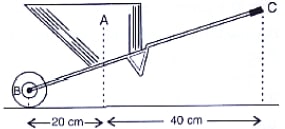
Find:
(a) the load arm,
(b) the effort arm,
(c) the mechanical advantage, and
(d) the minimum effort required to keep the leg just off the ground.
Ramesh went for fishing with his fishing rod. Identify the class of lever for a fishing rod. If a fish exerts a load of 10 N and the distance between fulcrum and fish is 1.5 m, and the effort applied is 0.5 m from the fulcrum, what is the force required by the fisher to pull the fish?
A fire tongs has its arms 20 cm long. It is used to lift a coal of weight 1.5 kgf by applying an effort at a distance 15 cm from the fulcrum.
Find:
(i) the mechanical advantage of fire tongs and
(ii) the effort needed.
The figure given below shows a fixed pulley used by a boy to lift a load of 200 N through a vertical height of 5 m in 10 s. The velocity ratio of the pulley is
- 0
- 1
- 2
- none
