
Physics
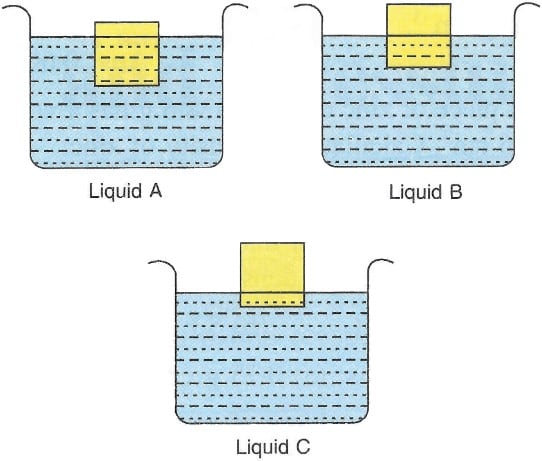
The diagram given below shows a body floating in three different liquids A, B and C at different levels.
(a) In which liquid does the body experience the greatest buoyant force?
(b) Which liquid has the least density?
(c) Which liquid has the highest density?
Measurements
57 Likes
Answer
(a) The buoyant force is same in each case as the weight of the body is same in each case and the buoyant force is equal to the weight of the liquid displaced by the immersed part of the body which balances the weight of the body.
(b) Liquid A has the least density as the maximum part of the body is immersed in liquid A.
(c) Liquid C has the highest density as the body immerses the least in liquid C.
Answered By
38 Likes
Related Questions
Which of the following will sink or float on water? (Density of water = 1 g cm-3)
- Body A having density 500 kg m-3
- Body B having density 2520 kg m-3
- Body C having density 1100 kg m-3
- Body D having density 0.85 g cm-3
The density of water is 1.0 g cm-3. The density of iron is 7.8 g cm-3. The density of mercury is 13.6 g cm-3. Answer the following:
(a) Will a piece of iron float or sink in water?
(b) Will a piece of iron float or sink in mercury?
Why does a piece of ice float on water?
Explain the following:
An egg sinks in fresh water, but floats in a strong salt solution.