Biology
The figure shown below represents the internal structure of a certain seed. Study the figure and answer the following questions.

(a) Identify the seed and mention whether it is mono or dicotyledonous.
(b) Label the guidelines 1 to 4.
(c) Write an important role of part 2.
(d) Mention the food component found in part 4.
(e) What kind of germination takes place in the above mentioned seed ?
Answer
(a) It is a Bean seed that is dicotyledonous.
(b) The labelled guidelines are:
- 1 → Plumule
- 2 → Radicle
- 3 → Testa
- 4 → Cotyledons
(c) Radicle grows downward into the soil and anchors the plant, absorbing water and nutrients from the ground. It develops into the primary root of the plant, which later gives rise to the entire root system.
(d) Protein
(e) Epigeal germination
Related Questions
Draw a neat and labelled diagram of :
(a) A twig of viviparous plant showing its germination.
(b) A seedling growing in soil.
Draw a neat and labelled diagram of the 'Experimental set-up of three-bean seed experiment' and mention the necessity of each condition for the germination of seeds.
Kiara visited a forest with marshy land. She observed that in some of the plants, the seeds germinate inside the fruit while still being attached to the parent plant. A part of the plant and a seedling are shown below in the diagram, answer the questions that follow.
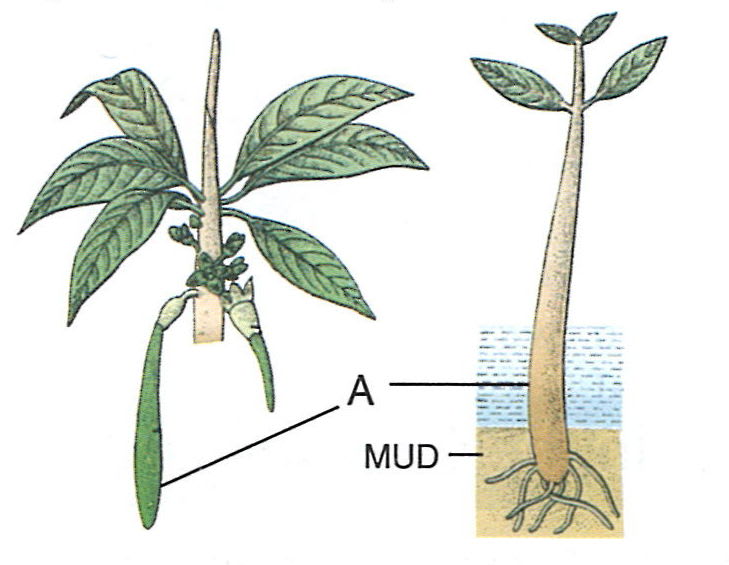
(a) What kind of germination is shown above in the figure ?
(b) Give two examples of the plants which germinate by this kind of germination.
(c) Mention the part shown in the figure as 'A'.
With regard to germination in bean seed, answer the following questions:
- State the function of the 'micropyle'.
- Name the part of the seed that grows into the seedling.
- Name the part of the seed that provides nutrition for the growing seedling.
- Draw a neat labelled diagram of a mature bean seed.