
Mathematics
The length of a hall is 18 m and its width is 13.5 m. Find the least number of square tiles, each of side 25 cm, required to cover the floor of the hall,
(i) without leaving any margin.
(ii) leaving a margin of width 1.5 m all around.
In each case, find the cost of the tiles required at the rate of ₹ 6 per tile.
Area Trapezium Polygon
14 Likes
Answer
(i) Given:
Length of the floor = 18 m
Breadth of the floor = 13.5 m
As we know, the area of the floor = length x breadth
= 18 x 13.5 m2
= 243 m2
Side of the square tile = 25 cm
= m
= m
As we know, the area of a tile = side2
= 2 m2
= m2
Area of square tiles x Number of tiles = Area of the floor
⇒ Number of tiles =
⇒ Number of tiles =
⇒ Number of tiles = 243 x 16
⇒ Number of tiles = 3,888
Rate per tile = ₹ 6 per tile
Total cost = ₹ 3,888 x 6
= ₹ 23,328
Hence, the number of tiles is 3,888 and the cost of the tiles is ₹ 23,328.
(ii) Width of the margin on each side = 1.5 m
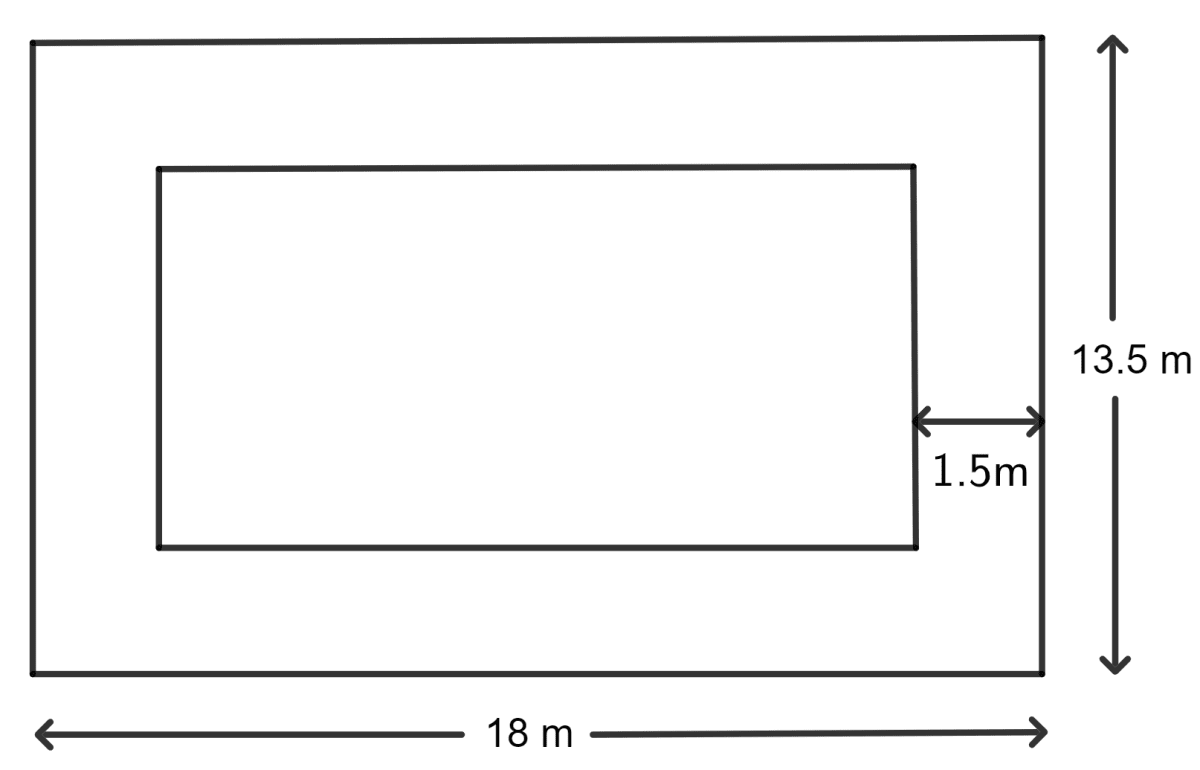
Length of the inner floor = 18 m - 1.5 m - 1.5 m
= 18 - 3 m
= 15 m
Breadth of the inner floor = 13.5 m - 1.5 m - 1.5 m
= 13.5 - 3 m
= 10.5 m
As we know, the area of the floor = length x breadth
= 15 x 10.5 m2
= 157.5 m2
Side of the square tile = 25 cm
= m
= m
As we know, the area of a tile = side2
= 2 m2
= m2
Area of square tiles x Number of tiles = Area of the floor
⇒ Number of tiles =
⇒ Number of tiles =
⇒ Number of tiles = 157.5 x 16
⇒ Number of tiles = 2,520
Rate of tiles = ₹ 6 per tile
Total cost = ₹ 2,520 x 6
= ₹ 15,120
Hence, the number of tiles is 2,520 and the cost of the tiles is ₹ 15,120.
Answered By
6 Likes
Related Questions
A path of uniform width, 3 m, runs around the outside of a square field of side 21 m. Find the area of the path.
A path of uniform width, 2.5 m, runs around the inside of a rectangular field 30 m by 27 m. Find the area of the path.
A rectangular field is 30 m in length and 22 m in width. Two mutually perpendicular roads, each 2.5 m wide, are drawn inside the field so that one road is parallel to the length of the field and the other road is parallel to its width. Calculate the area of the crossroads.
The length and the breadth of a rectangular field are in the ratio 5 : 4 and its area is 3380 m2. Find the cost of fencing it at the rate of ₹ 75 per m.