Chemistry
The setup shown below is that of the fountain experiment with hydrogen chloride gas in the flask.
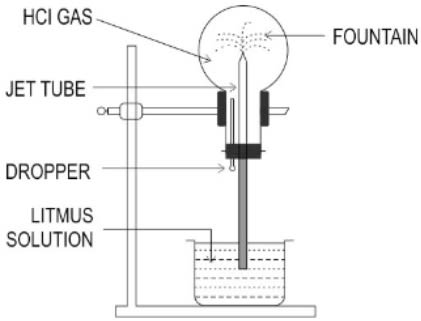
The fountain starts when a few drops of water from the dropper are introduced into the flask. Instead of the drops of water, Pooja started the fountain by introducing a few drops of Sodium hydroxide into the flask.
(a) Explain why the litmus solution gets sucked up when Sodium hydroxide is used.
(b) What will be the colour of the fountain when Sodium hydroxide is used? Justify your answer.
(c) If instead of HCl gas, ammonia gas is filled in the flask and water is introduced from the dropper, will there be a different observation? Justify your answer.
Answer
When sodium hydroxide is introduced into the flask, it undergoes a neutralization reaction with HCl to form salt and water:
HCl + NaOH ⟶ H2O + NaCl
As HCl is used up in the reaction, this lowers the pressure inside the flask. The outside pressure being higher pushes the litmus solution inside, through the jet tube.
(b) The colour of the litmus solution will remain unchanged so the fountain will be blue in colour.
HCl and sodium hydroxide undergo neutralization reaction to form salt and water which are neutral products. Hence, colour of litmus solution will not change.
(c) No the observation will be the same. Ammonia gas and water produce ammonium hydroxide which is basic in nature, hence again a blue colour fountain will be seen.
Related Questions
The catalyst used in Ostwald's process is …………… .
- Finely divided iron
- Graphite
- Vanadium pentoxide
- Platinum
An element belongs to third period and sixteenth group. It will have …………… electrons in its valence shell.
- 2
- 5
- 6
- 3
Match the following Column A with Column B.
Column A Column B (a) Aluminium 1. Covalent compound (b) Sulphuric acid 2. Carbonate ore (c) Calcination 3. Hall Heroult's process (d) Calcium Chloride 4. Contact Process (e) Carbon tetrachloride 5. Electrovalent compound Complete the following by choosing the correct answers from the bracket:
(a) If an element has one electron in the outermost shell then it is likely to have the ……………. [smallest/ largest] atomic size amongst all the elements in the same period.
(b) ……………. [sulphuric acid/ hydrochloric acid] does not form an acid salt.
(c) A ……………. [reddish brown/ dirty green] coloured precipitate is formed when ammonium hydroxide is added to a solution of ferric chloride.
(d) Alkanes undergo ……………. [addition/ substitution] reactions.
(e) An ……………. [alkaline/acidic] solution will turn methyl orange solution pink.