
Physics
Three solid objects A, B, and C have the same volume but different masses. They are released gently, one by one, into tanks containing three different liquids:
L1 (water), L2 (kerosene) and L3 (corrcentrated salt solution).
The observations made are as follows:
- Object A floats in L1 and L3 but sinks in L2.
- Object B sinks in L1, floats fully submerged in L3, and sinks faster in L2.
- Object C floats in all three liquids but with different heights submerged.
Answer the following:
(a) Arrange the liquids in increasing order of density, giving reasons.
(b) Identify the condition of flotation of object B in liquid L3. What inference can be drawn about the densities of the object and liquid?
(c) "As object C floats in all three liquids, the upthrust acting on it is the same in all three cases." Is this statement correct? Explain.
(d) If object A is heated (without any change in mass) and then placed in L1, what change, if any, will occur in its floating level?
(e) Two similar ships made of the same material float in fresh water and sea water respectively. Which ship displaces more water and why?
Archimedes' Principle
1 Like
Answer
(a) From the observations :
- Object A sinks in L2 but floats in L1 and L3, which means L2 has the least density i.e., ρL2 < ρA < ρL1, ρL3.
- Object B sinks in L1 but floats (fully submerged) in L3, indicating that L3 has the highest density i.e., ρL1 < ρB < ρL3.
- Since L1 lies between these two cases, its density is intermediate.
Hence, the increasing order of density is ρL2 (kerosene) < ρL1 (water) < ρL3 (concentrated salt solution).
(b) The condition of flotation is:
W = F'B
where,
W = weight of body acting vertically downwards
F'B = Maximum upthrust that can act on the body
As object B floats fully submerged in L3, hence, we can say that density of object B is equal density of liquid L3
∴ ρobject = ρL3
(c) The statement is correct because although object C floats in all three liquids, the upthrust acting on it is equal to its weight in each case, but the volume of liquid displaced is different depending on the density of the liquid.
In denser liquids, a smaller volume is displaced, while in less dense liquids, a larger volume is displaced so, while upthrust equals weight in all cases, the surrounding conditions like submerged volume differ.
(d) When object A is heated, its volume increases while its mass remains the same, leading to a decrease in its density so as a result, it will displace same amount of liquid to balance its weight but due to its larger volume it will be submerged less and hence will float higher in liquid L1.
(e) The ship floating in fresh water displaces more volume because fresh water has lower density compared to sea water so to balance its weight, the ship must displace a larger volume of fresh water, whereas in denser sea water, a smaller volume is sufficient to provide the required upthrust.
Answered By
1 Like
Related Questions
Assertion (A) : A bucket filled with water is heavier till it is immersed in water in well.
Reason (R) : The effect of upthrust is that the weight of body immersed in liquid appears to be lighter than its actual weight.
- both A and R are true and R is the correct explanation of A
- both A and R are true and R is not the correct explanation of A
- assertion is false but reason is true
- assertion is true but reason is false
Assertion (A) : An iron nail sinks in water, but floats in mercury.
Reason (R) : The density of iron is equal to density of mercury but greater than water.
- both A and R are true and R is the correct explanation of A
- both A and R are true and R is not the correct explanation of A
- assertion is false but reason is true
- assertion is true but reason is false
Assertion (A) : A loaded ship is submerged more while an unloaded ship is less submerged.
Reason (R) : A loaded ship displaces more water in comparison to an unloaded ship in order to float.
- both A and R are true and R is the correct explanation of A
- both A and R are true and R is not the correct explanation of A
- assertion is false but reason is true
- assertion is true but reason is false
The figure shows three identical solid cubes P, Q, and R of the same volume and material placed in three different liquids in identical vessels.
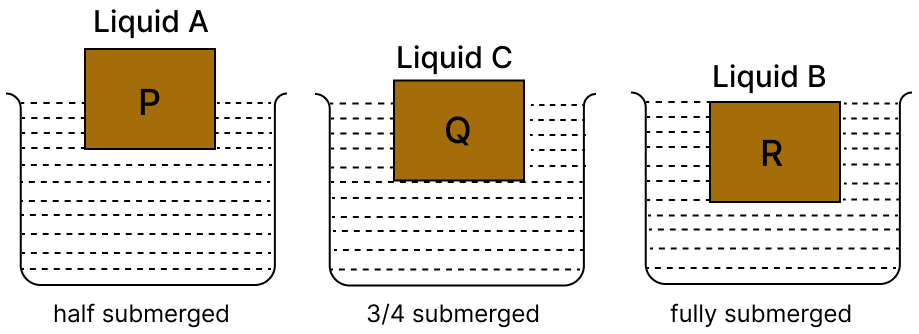
Answer the following :
(a) Arrange the liquids in increasing order of density.
(b) Identify the condition of flotation of cube R in liquid B. What information does this give about the densities of cube R and liquid B?
(c) Compare the upthrust acting on cubes P, Q, and R.
(d) If cube P is placed in liquid B, predict whether it will float higher, lower, or remain fully submerged. Give reason.
(e) Which liquid exerts the maximum buoyant force on a cube when it is fully immersed, and why?