
Mathematics
From the top of a hill the angles of depression of two consecutive kilometer stones, due east are found to be 30° and 45° respectively. Find the distance of the two stones from the foot of the hill.
Heights & Distances
1 Like
Answer
Given,
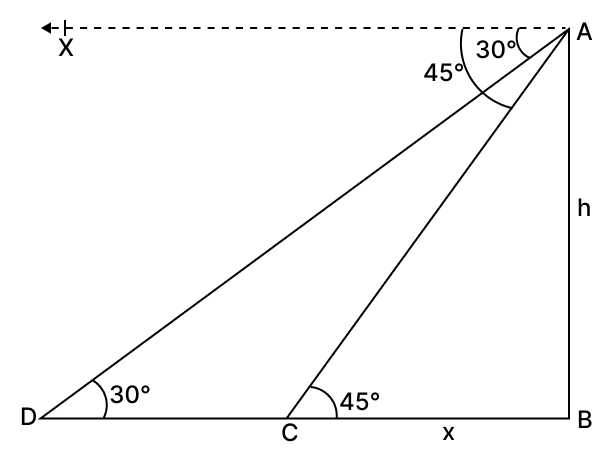
A is the top of the tower and B the foot. C and D be two consecutive kilometer stones with depression angles 30° and 45° respectively.
Since stones are consecutive kilometer stones hence distance between them = 1 km.
From figure,
∠XAD = ∠ADB = 30° [Alternate angles are equal]
∠XAC = ∠ACB = 45° [Alternate angles are equal]
CD = 1 km
DB = x + 1
From right angled ΔABC, we get
From right angled ΔADB, we get
DB = x + 1 = 1.36 + 1 = 2.36 km.
Hence, the distance of two stones from hill are 1.36 km and 2.36 km.
Answered By
3 Likes
Related Questions
A man observes the angle of elevation of the top of the tower to be 45°. He walks towards it in a horizontal line through its base. On covering 20 m, the angle of elevation changes to 60°. Find the height of the tower correct to 2 significant figures.
From the top of a cliff 60 m high, the angles of depression of two boats are 30° and 60° respectively. Find the distance between the boats, when the boats are:
(i) on the same side of the cliff,
(ii) on the opposite sides of the cliff.
An aeroplane at an altitude of 1500 m finds that two ships are sailing towards it in the same direction. The angles of depression as observed from the aeroplane are 45° and 30° respectively. Find the distance between the two ships.
An aeroplane at an altitude of 250 m observes the angle of depression of two boats on the opposite banks of a river to be 45° and 60° respectively. Find the width of the river. Write the answer to the nearest whole number.