
Mathematics
From the top of a lighthouse, the angles of depression of two ships on the opposite sides of it are observed to be α and β. If the height of the lighthouse be h metres and the line joining the ships passes through the foot of the lighthouse, the distance between the ships is:
Heights & Distances
1 Like
Answer
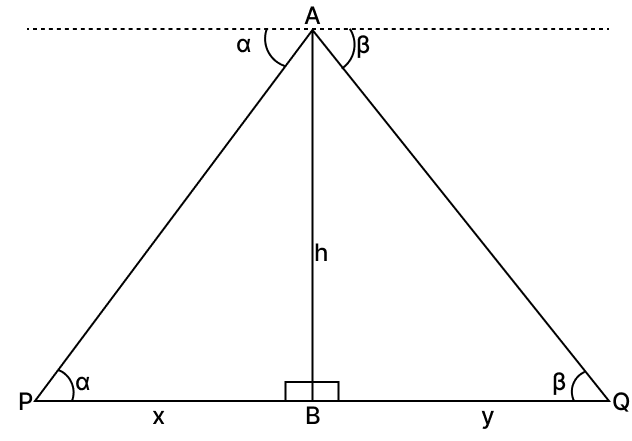
Let AB(h) be the height of the lighthouse.
Let P and Q be the two ships on opposite sides of the lighthouse.
Let BP = x meters and BQ = y meters.
In triangle ABP,
In triangle ABQ,
The total distance between the ships is = x + y
Hence, option 3 is the correct option.
Answered By
3 Likes
Related Questions
Two boats approach a lighthouse in mid-sea from opposite directions. The angles of elevation of the top of the lighthouse from the two boats are 30° and 45° respectively. If the distance between the two boats is 100 m, the height of the lighthouse is:
36.6 m
68.3 m
73.2 m
136.6 m
The angles of elevation of the top of a tower from two points distant 30 m and 40 m on either side from the base and in the same straight line with it are complementary. The height of the tower is :
11.54 m
23.09 m
34.64 m
69.28 m
A straight tree breaks due to storm and the broken part bends so that the top of the tree touches the ground making an angle of 30° with the ground. The distance from the foot of the tree to the point where the top touches the ground is 10 metres. The height of the tree is :
m
m
m
m
A person of height 2 m wants to get a fruit which is on a pole of height m. If he stands at a distance of m from the foot of the pole, then the angle at which he should throw the stone so that it hits the fruit is:
15°
30°
45°
60°