
Mathematics
Try to extend this method for constructing line segments of lengths and using a ruler and a compass. Generalise this method to construct a line segment of any length of the form , where is a positive integer.
Whole Numbers
1 Like
Answer
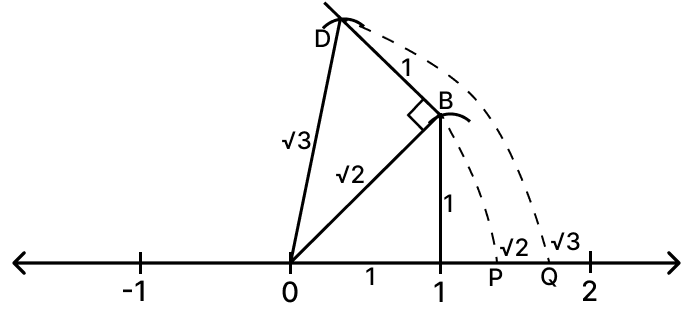
Construction of :
Step 1 : Construct OB = (as shown previously).
Step 2 : At B, draw a perpendicular BD of length 1 unit.
Step 3 : Join O to D. By the Pythagoras theorem :
⇒ OD2 = OB2 + BD2
⇒ OD2 = ()2 + 12
⇒ OD2 = 2 + 1 = 3
⇒ OD = .
Step 4 : With O as the centre and OD as the radius, draw an arc cutting the number line at point Q. Then OQ = .
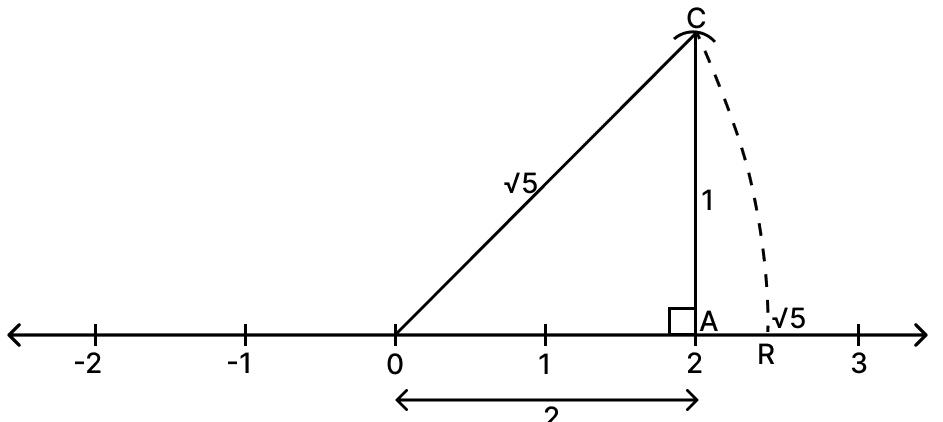
Construction of :
Step 1: On the number line, measure a horizontal segment OA = 2 units.
Step 2: At point A, draw a perpendicular line segment AC of length 1 unit.
Step 3: Join O to C. The length OC is:
⇒ OC2 = OA2 + AC2
⇒ OC2 = (2)2 + 12
⇒ OC2 = 4 + 1 = 5
⇒ OC = .
Step 4 : With O as the centre and OC as the radius, draw an arc cutting the number line at point R. Then OR = .
Generalisation to construct :
Suppose we have a line segment of length . Then at one end of this segment, draw a perpendicular of length 1 unit. The hypotenuse of the resulting right triangle will have length :
This method, when extended repeatedly starting from a unit segment, gives the famous "square root spiral".
Hence, by repeatedly applying the Pythagoras theorem with a unit perpendicular to a known segment of length , we can construct a line segment of any length of the form for any positive integer n.
Answered By
1 Like
Related Questions
Try to prove the irrationality of using the approach of proof by contradiction. Will the same approach work for , , or ?
We have seen how to obtain a line whose length is a rational number. How do we obtain lines whose lengths are irrational?
Try to find the decimal expansions of and . What do you observe about the repetition of the digits after the decimal point?
The decimal expansion of will be terminating precisely when the prime factors of are only 2, only 5 or both 2 and 5. Can you explain why?