
Physics
There are two copper wires of length ratio 1:2 that have their cross-sectional areas in the ratio 1:4. What will be the ratio of their:
(a) resistances?
(b) specific resistances?
Current Electricity
12 Likes
Answer
(a) We use the formula for resistance of a wire:
Where : R = resistance, = specific resistance (same for copper), L = length, A = cross-sectional area.
Since is the same for both:
(b) Specific resistance (resistivity) depends only on the material, and both wires are made of copper. So, specific resistance is the same for both.
Answered By
8 Likes
Related Questions
When Shyam, the band leader, struck both the bass drum and the kettle drum with equal force, the bass drum emitted a sound measuring 120 dB, whereas the kettle drum produced a sound of 90 dB. Explain this discrepancy in the loudness.
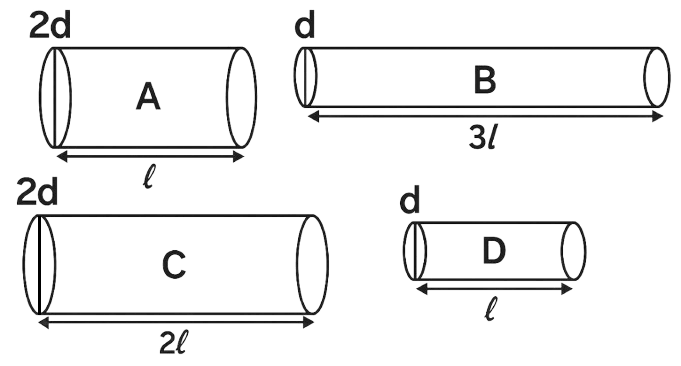
In the below diagram, calculate the ratio of the resistances A, B, C and D.
AB is an object and PQ is its real, inverted image. The lengths of AB and PQ are equal. This is possible when a lens is present between the object and its image.
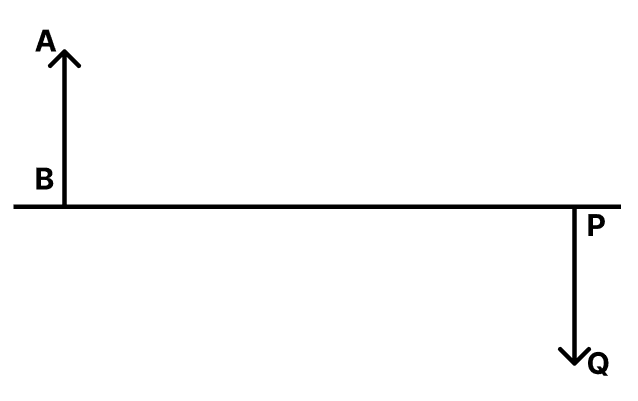
(a) What kind of lens is used here? Also, state the position of the lens and where it is to be placed.
(b) Name a device where this lens action is used.
The two metals A and B have their specific heat capacities in the ratio 2:3. If they are supplied the same amount of heat, then
(a) which metal piece will show a greater rise in temperature if their masses are the same?
(b) calculate the ratio in which their temperatures rise, if the mass ratio of metal A and metal B is 3:5.