
Mathematics
Two posts are k metres apart and the height of one is double that of the other. If from the middle point of the line joining their feet, an observer finds the angular elevations of their tops to be complementary, then the height (in metres) of the shorter post is:
Heights & Distances
1 Like
Answer
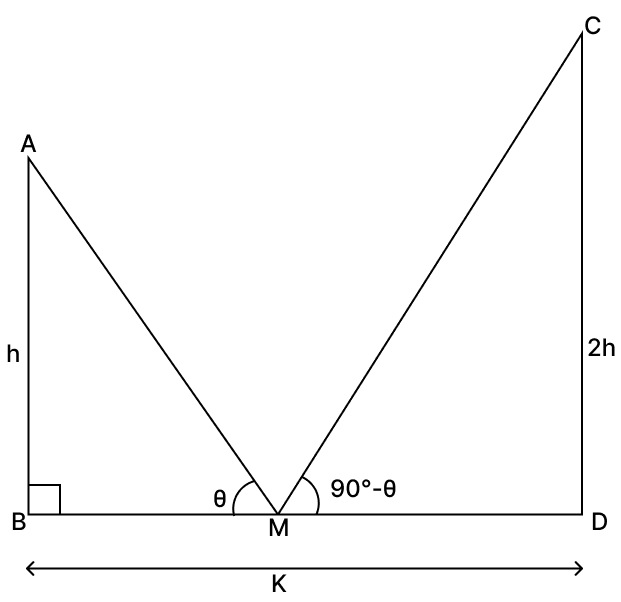
Let the height of the shorter post (AB) be h meters and the height of the the taller post (CD) be 2h meters..
Let the distance between the post be k meters.
Let M be the point of observation,
BM = MD =
In triangle ABM,
In triangle CDM,
From (1) and (2), we get :
Hence, option 1 is the correct option.
Answered By
1 Like
Related Questions
A flagstaff of height of the height of a tower is mounted on the top of the tower. If the angle of elevation of the top of the flagstaff as seen from the ground is 45° and the angle of elevation of the top of the tower as seen from the same place is θ, then the value of tan θ is:
Two poles of equal heights are standing opposite to each other on either side of a road, which is 30 m wide. From a point between them on the road, the angles of elevation of the tops are 30° and 60°. The height of each pole is:
4.33 m
6.5 m
13 m
15 m
From the top of a pillar of height 20 m, the angles of elevation and depression of the top and bottom of another pillar are 30° and 45° respectively. The height of the second pillar (in metres) is :
10
The angle of elevation of an aeroplane from a point on the ground is 45°. After 15 seconds of flight, the elevation changes to 30°. If the aeroplane is flying at a height of 3000 m, the speed of the plane in km per hour is:
152.16
263.5
304.32
527