
Physics
Two rays PQ and RS are incident on a rectangular glass block as shown in the diagram. Observe the diagram and answer the questions that follow.
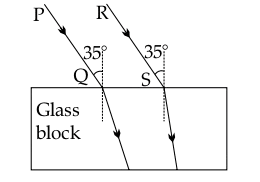
Which of these two rays will :
(a) have greater lateral displacement on emerging out of the block?
(b) travel with greater speed in the block?
(c) scatter more in the atmosphere?
Refraction Plane Surfaces
38 Likes
Answer
(a) Angle of incidence for both the rays being same, the directions of both the rays remain same. As the refracted ray corresponding to RS bends towards the normal is more than that corresponding to ray PQ hence, the lateral displacement of the emergent ray corresponding to incident ray RS will also be more.
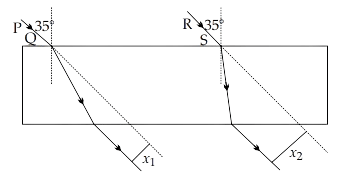
Diagram shows, x1 and x2 are the lateral shifts of the emergent rays corresponding to incident rays PQ and RS.
So, here x2 > x1
(b) Since, the refracted ray corresponding to incident ray PQ bends less towards the normal, hence this travels with greater speed.
(c) Speed corresponding to incident ray PQ is more than the speed corresponding to incident ray RS. So, wavelength corresponding to incident ray PQ is more than the wavelength corresponding to incident ray RS. So, RS will scatter more in atmosphere.
Answered By
29 Likes
Related Questions
(a) An object is placed at 2F position of a convex lens. Draw a ray diagram showing the formation of the image.
(b) How will the size of the image change if we, ONLY replace the lens in the above arrangement with another lens of a greater focal length?
An object is placed in front of a concave lens at a distance of 45 cm from it. If its image is formed at a distance of 30 cm from the lens, calculate the focal length of the lens.
(a) Name the radiations :
- for which a quartz prism is used to study the spectrum.
- which are used in remote sensing devices.
- which are used in traffic signals in India.
(b) Name one property common to all electromagnetic radiations.
Akash takes a uniform metre scale and suspends a weight of 2 N at one end ‘X’, and a weight of 5 N on the other end ‘Y”. He then balances the ruler horizontally on a knife edge placed at 70 cm from X. Draw a diagram of the arrangement and calculate the weight of the ruler.