Mathematics
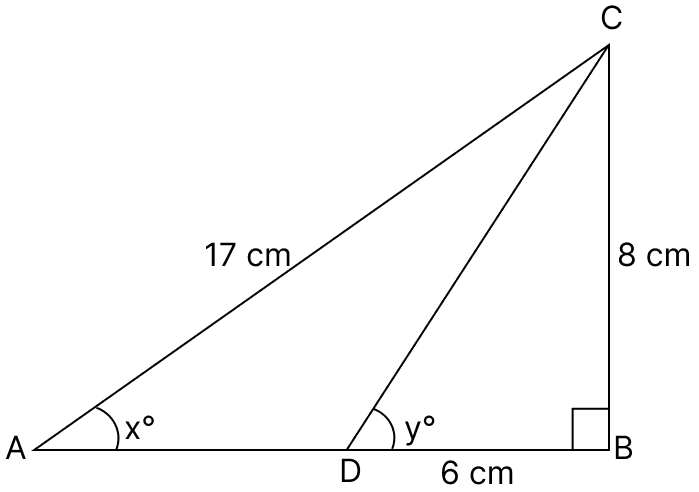
Use the adjoining figure and write the values of :
(i) sin x°
(ii) cos y°
(iii) 3 tan x° - 2 sin y° + 4 cos y°
Trigonometrical Ratios
2 Likes
Answer
In right angled triangle DBC,
Perpendicular = BC = 8 cm
Base = DB = 6 cm
Then we will find hypotenuse (CD) by pythagoras theorem,
Hypotenuse2 = Base2 + Perpendicular2
Hypotenuse2 = 62 + 82
Hypotenuse2 = 36 + 64
Hypotenuse2 = 100
Hypotenuse = 10 cm
In right angled triangle ABC,
Perpendicular = CB = 8 cm
Hypotenuse = AC = 17 cm
Let AD = m
Base (AB) = AD + DB = m + DB
By pythagoras theorem,
Base2 = Hypotenuse2 - Perpendicular2
(m + 6)2 = 172 - 82
m2 + 36 + 12m = 289 - 64
m2 + 36 + 12m = 225
m2 + 12m + 36 - 225 = 0
m2 + 12m - 189 = 0
m2 + 21m - 9m - 189 =0
m(m + 21) - 9(m + 21) = 0
(m + 21)(m - 9) = 0
m = -21 or m = 9
Sicne, length can't be negative.
so, m = 9 cm
AB = m + 6 = 9 + 6 = 15 cm
(i) sin x° = .
(ii) cos y° = .
(iii) 3 tan x° - 2 sin y° + 4 cos y°
tan x° =
sin y° =
Putting values of tan x°, sin y°, cos y° in 3 tan x° - 2 sin y° + 4 cos y°
=
=
= .
Answered By
2 Likes