Mathematics
Use a graph paper for this question (Take 2 cm = 1 unit on both x and y axis).
(i) Plot the following points : A(0, 4), B(2, 3), C(1, 1) and D(2, 0)
(ii) Reflect points B, C, D on the y-axis and write down their co-ordinates. Name the images as B', C', D' respectively.
(iii) Join the points A, B, C, D, D', C', B' and A in order, so as to form a closed figure. Write down the equation of the line of symmetry of the figure formed.
Answer
(i) The point A(0, 4), B(2, 3), C(1, 1) and D(2, 0) are plotted on the graph below:
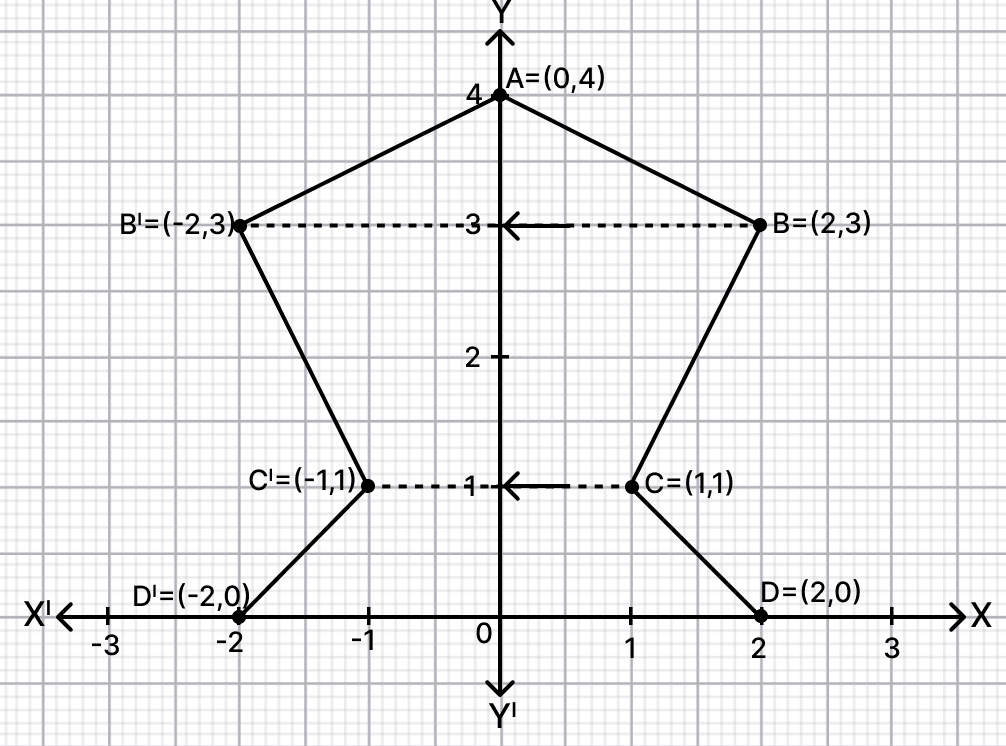
(ii) From graph, on reflecting B, C, D on y-axis we get,
B(2, 3) ⇒ B'(-2, 3)
C(1, 1) ⇒ C'(-1, 1)
D(2, 0) ⇒ D'(-2, 0).
(iii) From graph we see that the figure is divided into two symmetrical parts by y-axis.
Hence, the equation of line of symmetry is x = 0.
Related Questions
The vertices of a Δ ABC are A(2, -3), B(-1, 2) and C(3, 0). This triangle is reflected in x-axis to form ΔA'B'C'. Find the co-ordinates of A', B' and C'. Are the two triangles congruent?
The points P(-2, 4), Q(3, -1) and R(6, 2) are the vertices of a triangle. Δ PQR is reflected in y-axis to form ΔP'Q'R'. Find the co-ordinates of P', Q' and R'.
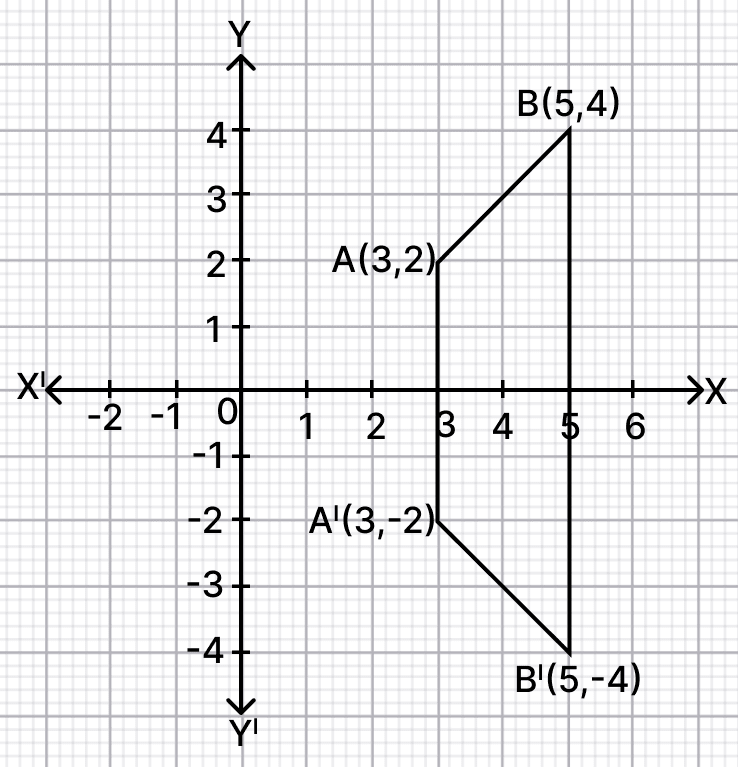
(i) Plot the points A(3, 2) and B(5, 4) on a graph paper.
(ii) Reflect A and B in the x-axis to A' and B' respectively. Plot A' and B' on the same graph paper. Write the co-ordinates of A' and B'.
(iii) Write down :
(a) the geometrical name of the figure ABB'A'.
(b) m∠ABB'.
(c) the image A" of A when reflected in the origin.
(d) the single transformation that maps A' to A".Points P and Q have co-ordinates (0, 5) and (-2, 4).
(i) P is invariant when reflected in an axis. Name the axis.
(ii) Find the image of Q on reflection in the axis found in (i).
(iii) (0, k) on reflection in the origin is invariant. Write the value of k.
(iv) Write the co-ordinates of the image of Q, obtained by Reflecting it in the origin followed by reflection in the x-axis.