
Mathematics
Use the graphical method to find the value of 'x' for which the expressions and are equal.
Graphical Solution
3 Likes
Answer
First equation: y =
Step 1:
Give at least three suitable values to the variable x and find the corresponding values of y.
Let x = -4, then y = ⇒ y = -5
Let x = -2, then y = ⇒ y = -2
Let x = 2, then y = ⇒ y = 4
Step 2:
Make a table (as given below) for the different pairs of the values of x and y:
| x | -4 | -2 | 2 |
|---|---|---|---|
| y | -5 | -2 | 4 |
Step 3:
Plot the points, from the table, on a graph paper and then draw a straight line passing through the points plotted on the graph.
Second equation: y =
Step 1:
Give at least three suitable values to the variable x and find the corresponding values of y.
Let x = -4, then y = ⇒ y = -5
Let x = 4, then y = ⇒ y = 1
Let x = 8, then y = ⇒ y = 4
Step 2:
Make a table (as given below) for the different pairs of the values of x and y:
| x | -4 | 4 | 8 |
|---|---|---|---|
| y | -5 | 1 | 4 |
Step 3:
Plot the points, from the table, on a graph paper and then draw a straight line passing through the points plotted on the graph.
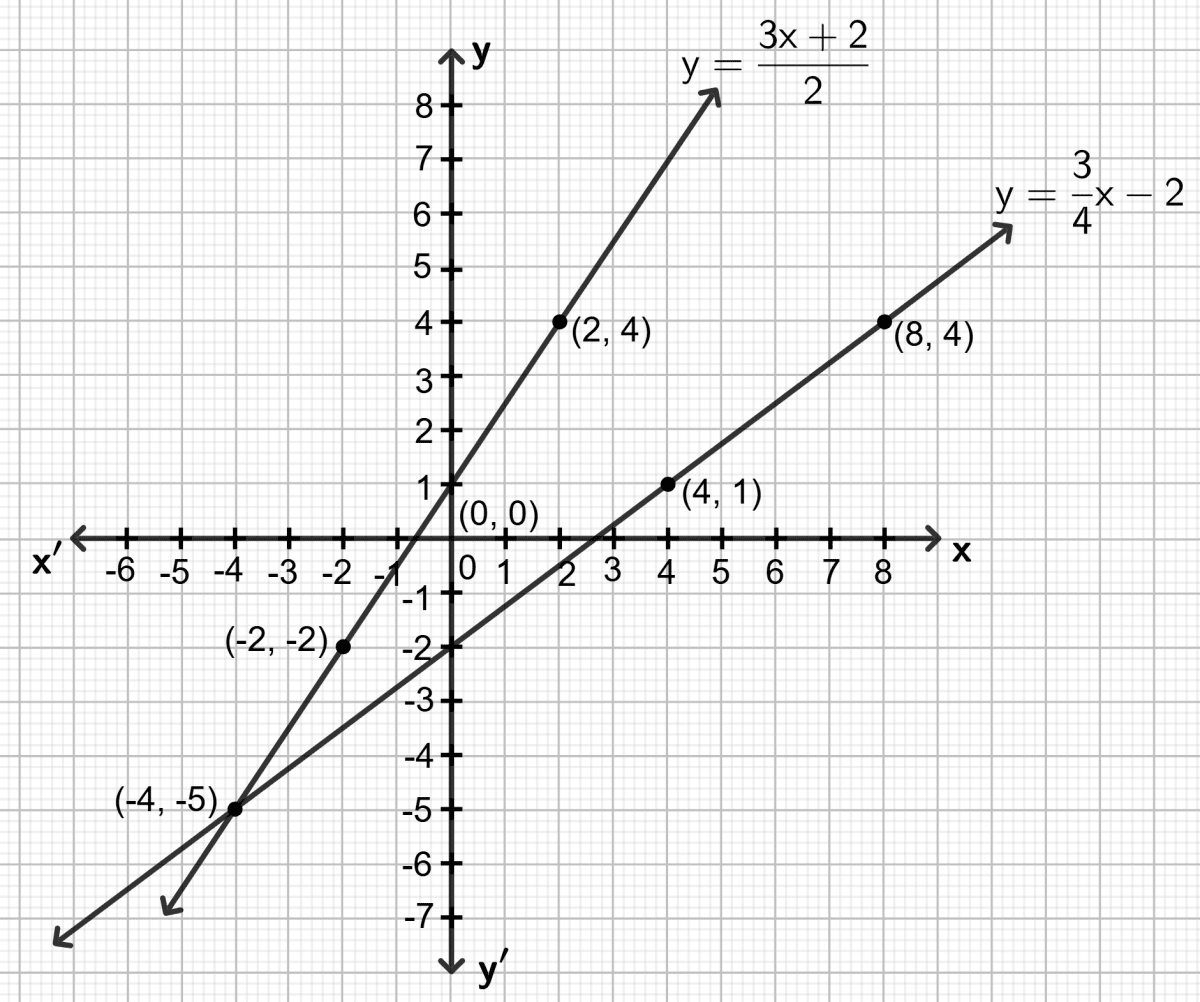
After plotting both lines on the graph, observe where the two lines intersect. The intersection point represents the value of x where both equations are equal.
From the graph, we see that the lines intersect at x = -4.
Hence, the value of x for which the two equations are equal is -4.
Answered By
2 Likes
Related Questions
Using the same axes of co-ordinates and the same unit, solve graphically :
x + y = 0 and 3x - 2y = 10.
(Take at least 3 points for each line drawn).
Solve graphically, the following equations.
x + 2y = 4; 3x - 2y = 4.
Take 2 cm = 1 unit on each axis.
Also, find the area of the triangle formed by the lines and the x-axis.
The course of an enemy submarine, as plotted on rectangular co-ordinate axes, gives the equation 2x + 3y = 4. On the same axes, a destroyer's course is indicated by the graph x - y = 7. Use the graphical method to find the point at which the paths of the submarine and the destroyer intersect.
An equation which can be put in the form ax + by + c = 0 is called a linear equation, where :
(i) x and y are variables,
(ii) a,b and c are real numbers and
(iii) a and b are both not zero.
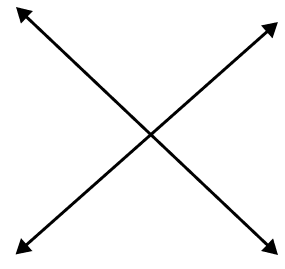
On drawing a graph for the two linear equations on the same plane, it is seen that only one of the following three posibilities can happen:
(i) the two lines intersect at one point.
(ii) the two lines do not intersect (i.e. the lines are parallel to each other)

(iii) the two lines coincide (i.e. the lines have infinite number of solutions).

On comparing the ratios , find out whether the lines representing the following pairs of linear equations intersect at a point, are parallel or coincident.
(i) 7x - 5y + 10 = 0
6x + 2y - 15 = 0
(ii) 5x + 2y + 8 = 0
15x + 6y + 24 = 0
(iii) 4x - 8y + 9 = 0
2x - 4y + 7 = 0
(iv) x - 2y = 0
3x - 4y - 20 = 0
(v) 2x + 3y - 9 = 0
4x + 6y - 18 = 0
(vi) x + 2y - 4 = 0
2x + 4y - 12 = 0