
Mathematics
Using only a ruler and compasses, construct ∠ABC = 120°, where AB = BC = 5 cm.
(a) Mark two points D and E which satisfy the condition that they are equidistant from both BA and BC.
(b) In the above figure, join AE and EC. Describe the figures.
(i) ABCD
(ii) BD
(iii) ABE
Locus
3 Likes
Answer
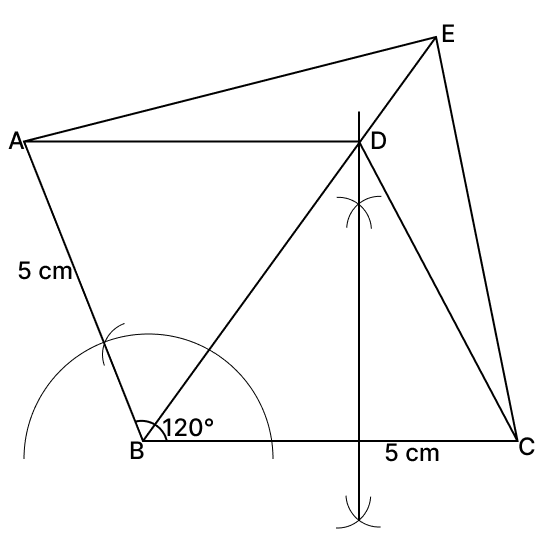
Steps of construction :
Draw a straight line segment BC = 5 cm.
From B with radius 5cm mark an arc as A.Construct ∠ABC = 120° .
Join AB, so that ∠ABC = 120° and AB = 5 cm.
Construct the angle bisector BE of ∠ABC.
Draw perpendicular bisector of BC. Mark the point of intersection of bisectors as D.
Join AD and DC.
E lies on the angle bisector of ∠ABC.
Join AE and CE.
(i) ABCD is a rhombus.
(ii) BD is angle bisector of ∠ABC.
(iii) ABE is a triangle.
Answered By
2 Likes
Related Questions
Draw a circle of radius 4 cm and mark two chords AB and AC of the circle of length 6 cm and 5 cm respectively.
(i) Construct the locus of points inside the circle, that are equidistant from A and C.
(ii) Construct the locus of points, inside the circle, that are equidistant from AB and AC.
A and B are fixed points 5 cm apart. The locus of the point P is the set of those points for which AP = 4 cm and the locus of Q is the set of those points for which BQ = 3.5 cm.
Construct the loci of P and Q and the points of intersection of the two loci. How many such points are there?Using ruler and compasses only,
(i) Construct a ΔABC in which BC = 6 cm, ∠ABC = 120° and AB = 3.5 cm.
(ii) In the above figure, draw a circle with BC as diameter. Find a point P on the circumference of the circle which is equidistant from AB and BC. Measure ∠BCP.
Use a ruler and a pair of compasses to construct ΔABC in which BC = 4.2 cm, ∠ABC = 60° and AB = 5 cm. Construct a circle of radius 2 cm to touch both the arms of ∠ABC of ΔABC.