
Mathematics
Using ruler and compasses only, construct a ΔABC in which AB = 4 cm, BC = 5 cm and ∠ABC = 120°.
(i) Locate the point P such that ∠BAP = 90° and BP = CP.
(ii) Measure the length of BP.
Locus
2 Likes
Answer
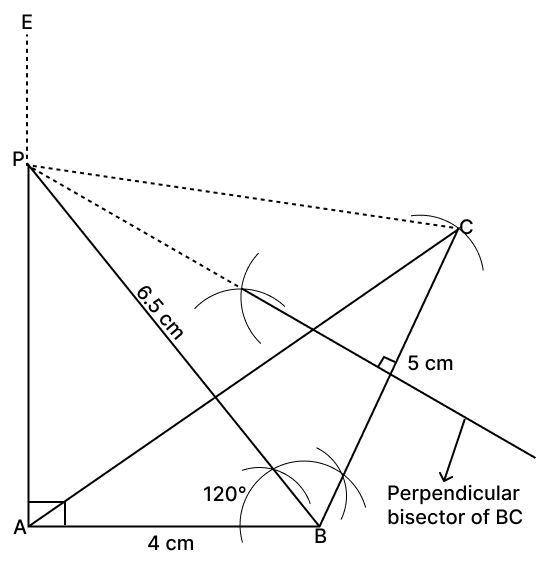
Steps of construction:
Draw AB of length 4 cm.
Make angle 120° at B, draw an arc of radius 5 cm from point B on this angle. Join BC and AC.
At point A, draw a line AE ⟂ AB.
Draw perpendicular bisector of BC
(i) Mark the point of intersection of bisector and AE as P. Thus BP = CP, as point P lies on perpendicular bisector of BC.
(ii) On measuring, BP = 6.5 cm.
Answered By
3 Likes
Related Questions
AB and CD are two intersecting lines. Find the position of the point distant 2 cm from AB and 1.8 cm from CD.
Using ruler and compasses only, construct a rhombus ABCD whose diagonals AC and BD are 8 cm and 6 cm long respectively. Find by construction a point P equidistant from AB and AD and also equidistant from C and D. Measure PC.
Using ruler and compasses only, construct a ΔABC in which AB = 6 cm, BC = 3.5 cm and CA = 4.6 cm.
(i) Draw the locus of a point P which moves so that it is always 3 cm from B.
(ii) Draw the locus of a point which moves so that it is equidistant from BC and CA.
(iii) Mark the point of intersection of the two loci obtained above. Measure PC.
Using ruler and compasses only, construct an isosceles ΔABC in which BC = 5 cm, AB = AC and ∠BAC = 90°. Locate the point P such that :
(i) P is equidistant from BC and AC.
(ii) P is equidistant from B and C.