Mathematics
Using ruler and compasses only, construct a ΔABC such that AB = 4.6 cm, BC = 3 cm and ∠ABC = 30°. Complete the rhombus ABDE such that C is equidistant from AB and BD. Locate the point Q on BC such that Q is equidistant from A and B.
Answer
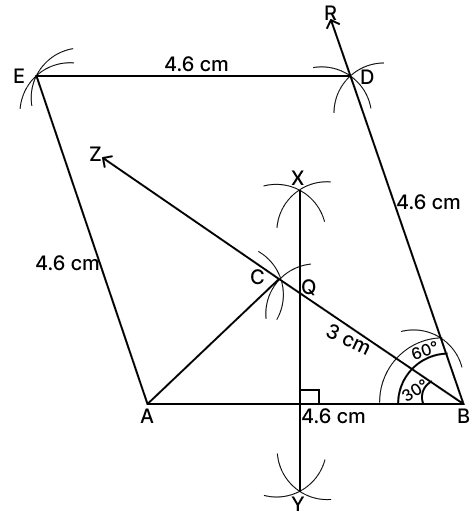
Steps of construction:
Draw a line segment AB = 4.6 cm.
Draw BZ such that ∠ABZ = 30°.
From BZ cut off BC = 3 cm, ∠ABC = 30°.
Join AC.
Since, C is equidistant from AB and BD, thus it will lie on the angle bisector of angle between AB and BD. Since, ∠ABC = 30°.
∴ ∠ABR = 60°
Draw ∠ABR = 60°.
From BR cut off BD = 4.6 cm, ∠ABD = 60° .
With D and A as center draw arcs of 4.6 cm cutting each other at point E.
Join DE and AE. Complete the rhombus ABDE .
Draw XY, the perpendicular bisector of AB.
Mark point Q as the intersection point of BC and XY.
Related Questions
Construct ∠AOB = 60°. Mark a point P equidistant from OA and OB such that its distance from another given line CD is 3 cm.
ABC is an equilateral triangle of side 3.2 cm. Find the points on AB and AB produced which are 2 cm from BC.
AB and CD are two intersecting lines. Find the position of the point distant 2 cm from AB and 1.8 cm from CD.
Using ruler and compasses only, construct a rhombus ABCD whose diagonals AC and BD are 8 cm and 6 cm long respectively. Find by construction a point P equidistant from AB and AD and also equidistant from C and D. Measure PC.