
Mathematics
Using ruler and compasses only, construct a parallelogram ABCD in which AB = 5.1 cm, diagonal AC = 5.6 cm and diagonal BD = 7 cm. Locate the point P on DC, which is equidistant from AB and BC.
Locus
3 Likes
Answer
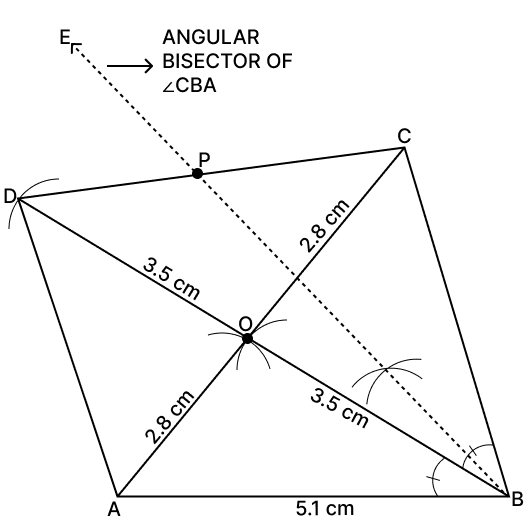
Steps of construction :
Draw AB = 5.1 cm as base.
At A, with radius 2.8 cm and at B with radius 3.5 cm draw two arcs intersecting each other at O.
Join AO and produce it till C such that OC = AO = 2.8 cm and join BO and produce it till D such that OD = BO = 3.5 cm.
Join A, B, C and D forming parallelogram ABCD.
We know that locus of point equidistant from two lines is the angle bisector of the two lines.
From figure,
BE is the angle bisector of ∠ABC which meets DC at P.
Answered By
2 Likes
Related Questions
Using ruler and compasses only, construct an isosceles ΔABC in which BC = 5 cm, AB = AC and ∠BAC = 90°. Locate the point P such that :
(i) P is equidistant from BC and AC.
(ii) P is equidistant from B and C.
Using ruler and compasses only, construct a quadrilateral ABCD in which AB = 6 cm, BC = 5 cm, ∠B = 60°, AD = 5 cm and D is equidistant from AB and BC.
Draw a circle of radius 4 cm and mark two chords AB and AC of the circle of length 6 cm and 5 cm respectively.
(i) Construct the locus of points inside the circle, that are equidistant from A and C.
(ii) Construct the locus of points, inside the circle, that are equidistant from AB and AC.
A and B are fixed points 5 cm apart. The locus of the point P is the set of those points for which AP = 4 cm and the locus of Q is the set of those points for which BQ = 3.5 cm.
Construct the loci of P and Q and the points of intersection of the two loci. How many such points are there?