
Mathematics
Using ruler and compasses construct
(i) a triangle ABC in which AB = 5.5 cm, BC = 3.4 cm and CA = 4.9 cm.
(ii) the locus of points equidistant from A and C.
(iii) a circle touching AB at A and passing through C.
Locus
1 Like
Answer
(i) The figure below shows the constructed triangle ABC:
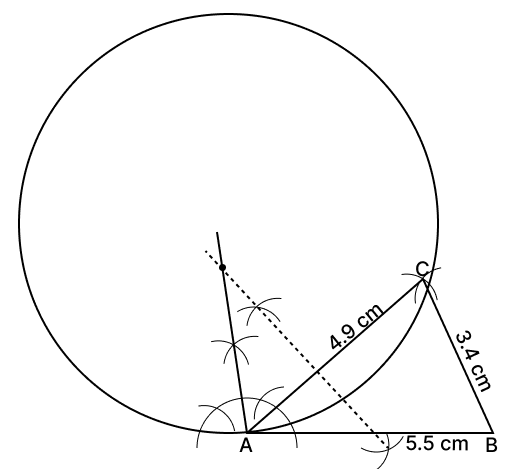
Steps of construction,
Draw AB = 5.5 cm.
With A as centre and 4.9 cm radius draw an arc.
With B as centre and 3.4 cm radius cut the previous arc. Mark point of intersection as C.
Draw a right angle at A and perpendicular bisector to AC.
Mark point of intersection as O. With OA as radius draw a circle.
(ii) From figure we can see,
The locus of points A and C will be the perpendicular bisector of the line segment joining A and C.
Answered By
2 Likes
Related Questions
Using ruler and compasses only,
(i) Construct a ΔABC in which BC = 6 cm, ∠ABC = 120° and AB = 3.5 cm.
(ii) In the above figure, draw a circle with BC as diameter. Find a point P on the circumference of the circle which is equidistant from AB and BC. Measure ∠BCP.
Use a ruler and a pair of compasses to construct ΔABC in which BC = 4.2 cm, ∠ABC = 60° and AB = 5 cm. Construct a circle of radius 2 cm to touch both the arms of ∠ABC of ΔABC.
The locus of a point which moves in a plane in such a way that its distance from a fixed point is always constant, is known as :
a square
an equilateral triangle
a circle
a parallelogram
The locus of a point which is equidistant from two given fixed points, is the of the line segment joining the given fixed points.
median
angle bisector
altitude
perpendicular bisector