Mathematics
Using ruler and compasses only :
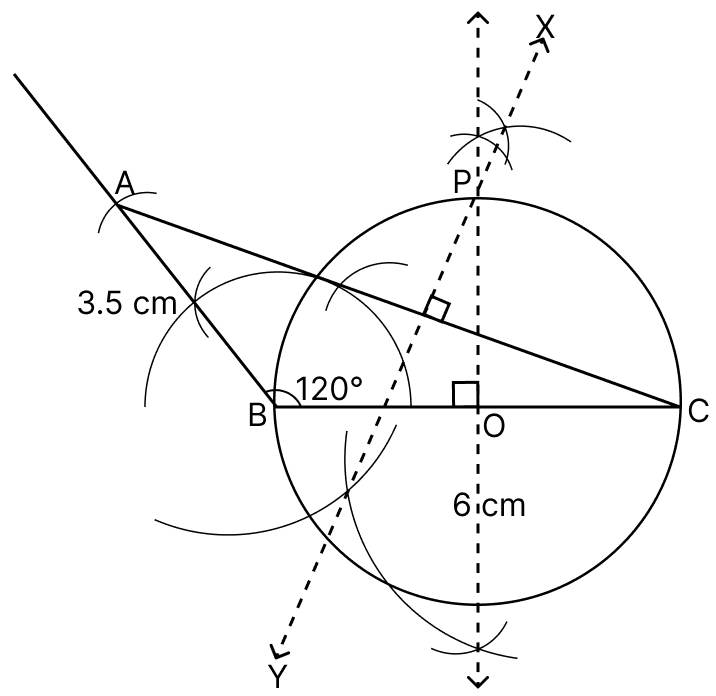
(i) Construct a triangle ABC with following data : AB = 3.5 cm, BC = 6 cm and ∠ABC = 120°.
(ii) In the same diagram, draw a circle with BC as diameter. Find a point P on the circumference of the circle drawn which is equidistant from A and C.
Answer
Steps of construction :
Draw a line segment BC = 6 cm.
At point B, construct an angle of 120° with BC.
On the ray forming the angle, mark point A such that AB = 3.5 cm.
Join AC. Thus, △ABC is constructed.
To draw the circle with BC as diameter, construct the perpendicular bisector of BC.
Let the perpendicular bisector meet BC at O. Then O is the midpoint of BC.
With centre O and radius OB or OC, draw a circle. This is the required circle with BC as diameter.
Now, to find a point P on the circle which is equidistant from A and C, construct XY, the perpendicular bisector of AC.
Let XY, the perpendicular bisector of AC meet the circle at point P.
Then PA = PC, because every point on the perpendicular bisector of AC is equidistant from A and C.
Related Questions
Construct a triangle ABC in which AB = 5 cm, BC = 6.8 cm and median AD = 4.4 cm. Draw incircle of this triangle.
Draw two concentric circles with radii 4 cm and 6 cm. Taking a point on the outer circle, construct a pair of tangents to inner circle. By measuring the lengths of both the tangents, show that they are equal to each other.
In triangle ABC, ∠ABC = 90°, side AB = 6 cm, side BC = 7.2 cm and BD is perpendicular to side AC. Draw circumcircle of triangle BDC and then state the length of the radius of this circumcircle drawn.
Construct a triangle ABC with ∠ABC = 60°, AB = 6 cm and BC = 5 cm. Extend side AB to a point D so that AD = 9 cm. Also, extend side AC to a point E so that AE = 8 cm. Construct a circle which must touch AB produced, BC and AC produced.